

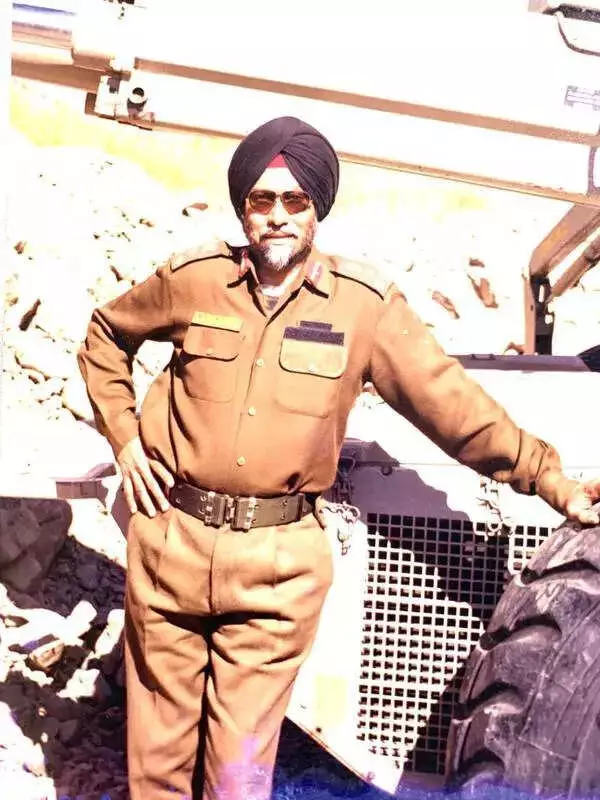
As India prepares to commemorate Vijay Diwas, marking the victory in the 1971 war, a decorated veteran shares a powerful memory that underscores the legendary leadership ethos of Indian Army officers. Major General Lakhwinder Singh (retd), 77, who hung up his boots in 2006 after nearly four decades of service, recalls a surprising compliment from an adversary that has stayed with him for over five decades.
A Fateful Meeting on the Border
Commissioned in December 1967, Maj Gen Singh fought the 1971 war as a 23-year-old captain with a Field Regiment in the Dera Baba Nanak sector of Punjab. A few days after the ceasefire was declared on December 16, he was tasked with leading a small contingent to exchange sweets and Eid greetings with Pakistani soldiers at a common spot near the border.
"After the formalities, one of them inquired about the officer who had handled the artillery on our side, which was me," Maj Gen Singh recounted from his Delhi home. "Our men did not reveal my identity but asked why. They replied it was because our artillery had caused them heavy damage."

What followed was a statement that left a lasting impression. A Pakistani soldier looked towards him and said, "Agar India ke officers aur Pakistan ke jawan mil jaayen to duniya mein koi humein shikast nahi de sakta (If Indian officers and Pakistani soldiers come together, no one in the world could defeat us)." The young officer simply smiled and thanked him.
The Ethos of Leading from the Front
Maj Gen Singh described this moment as a testament to the ingrained culture of Indian Army officers leading their men from the front, a stark contrast to the practices often observed on the other side. He clarified that his statement was not a comment on the bravery of Pakistani soldiers, whom he acknowledged as courageous, but on the leadership style of their officers.
"In the 1971 war, we largely encountered Pakistani JCOs and NCOs fighting at the front, which further reinforced that soldier's remark," he added. This perception, he revealed, was echoed more than two decades later during the Kargil War in 1999, suggesting stories about Indian officers' valor were passed down through generations in the Pakistani ranks.
Lieutenant General Mohan Bhandari (retd), who served with Maj Gen Singh in Kargil, corroborated this view. "It is well known that Pakistani officers rarely lead their men from the front, unlike Indian Army officers," he stated. "Indian officers are trained to lead from the front, not issue orders from behind. That is why the proportion of Indian Army officers making the supreme sacrifice during conflicts is higher."
A Divine Intervention in Battle
The veteran also shared another unforgettable incident from December 6, 1971, in the same sector, which he describes as "something divine." During an attack on a Pakistani enclave, his unit, which included soldiers from the 1/3 Gorkha Rifles, encountered an enemy pillbox.
"We fired upon it for three to four minutes—a significant duration in combat—and were certain no one inside could have survived," he said. "Just then, a Pakistani soldier emerged and ran for safety. We froze and could not pull the trigger. It felt like the Almighty had willed that he live."
Maj Gen Singh, also credited with innovative artillery use that turned the tide during the Kargil War, concludes that these experiences are not just war stories but reflections of the character and values instilled in India's military leadership. As the nation celebrates its military triumph, these recollections serve as a powerful reminder of the human moments and profound respect that transcend the fog of war.






