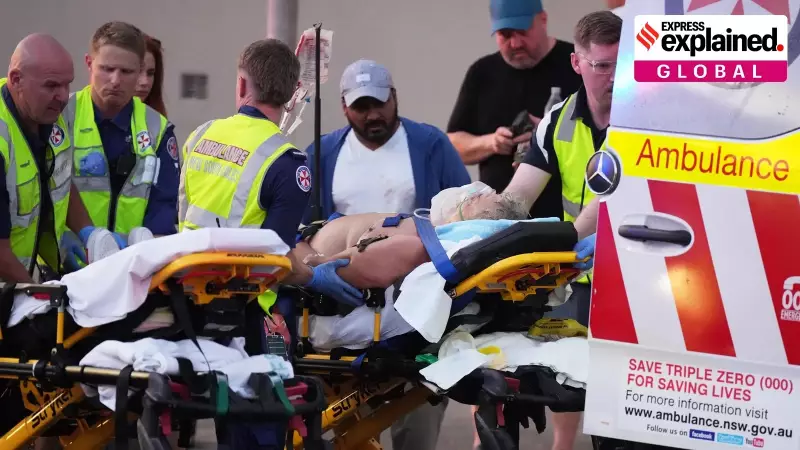
Australian authorities are investigating a deadly terror attack at Sydney's Bondi Beach with a crucial international link emerging. The father-son duo responsible for the shooting, which targeted the Jewish community, had travelled to the southern Philippines for military-style training weeks before the incident.
The Philippines Connection and Attack Details
The attackers, identified as Indian national and Australian resident Sajid Akram, 50, and his Australian national son Naveed Akram, 24, flew from Sydney to Manila on November 1. Their itinerary included a visit to Davao City on the island of Mindanao before departing the Philippines on November 28. The Bureau of Immigration in the Philippines confirmed their travel details.
The shooting occurred on Sunday, December 14, 2025, resulting in a tragic loss of life and injuries. Fifteen people were killed, and 25 others were hospitalised. Sajid Akram died during an exchange of gunfire with police, while his son Naveed was taken into custody.

Australian Prime Minister Anthony Albanese stated that evidence pointed to the attack being "inspired by a terrorist organisation, by ISIS." A senior counterterrorism official, quoted by the Australian Broadcasting Corporation, claimed the pair "underwent military-style training in the southern Philippines last month."
Mindanao: A Decades-Long Hotbed for Militancy
The southern Philippine island of Mindanao, the nation's second-largest, has a complex history of conflict. It is home to a large Muslim population, known as the Moros, in a country that is predominantly Roman Catholic. This demographic difference stems from colonial-era policies that marginalised the Moros and encouraged Christian settlement in the south.
For decades, the region has been a centre for separatist and militant activity. Groups like the Moro National Liberation Front (MNLF) emerged in the 1960s and 70s, framing their struggle for self-determination in Islamic terms. The most notorious among them is the Abu Sayyaf Group (ASG), known for terrorist bombings, kidnappings, and beheadings.
The rise of the Islamic State (ISIS) added a new, global dimension to this local conflict. By late 2015, ISIS-affiliated groups in Mindanao united under the banner "Daulah Islamiyah Wilayatul Mashriq" (Islamic State-Eastern Region). This alliance included factions of the ASG, the Maute Group, and the Bangsamoro Islamic Freedom Fighters (BIFF).
The Marawi Siege and Australia's Role
The most significant manifestation of this ISIS influence was the five-month siege of Marawi City in 2017. Militants seized control, leading to a massive military response involving airstrikes. The battle left the city centre in ruins, killed over 1,130 people, and displaced approximately 600,000 residents.
Australia played a supportive role during this crisis. Australian P-3 Orion aircraft conducted surveillance missions to gather intelligence for Philippine forces. In 2018, Australia pledged AU$ 25 million for Marawi's recovery. The Australian government has also proscribed terrorist organisations operating in the region, including Islamic State East Asia (ISEA) and the ASG.
While Australia's National Security website notes no known current links between ISEA and Australia, it acknowledges past connections between Australians and Philippine terror groups. It warns that Australians could be at risk due to the country's significant business and tourist presence in the Philippines.
A Precarious Path to Peace
Despite the decline of the Islamic State's territorial caliphate, the threat of lone-wolf attacks persists, as seen in a bombing at a Catholic mass in Marawi in December 2023. The Philippine government has pursued peace processes with some groups over the years. A significant milestone was the 2014 peace agreement with the Moro Islamic Liberation Front (MILF), leading to the creation of the Bangsamoro Autonomous Region in 2019.

However, challenges remain. Elections for the region were recently halted by the Supreme Court, and hurdles like disarmament, financial constraints, and bureaucratic delays continue to test the fragile peace. The Bondi Beach attack underscores how training and ideology from this volatile region can have deadly consequences thousands of miles away, prompting continued international counter-terrorism cooperation.