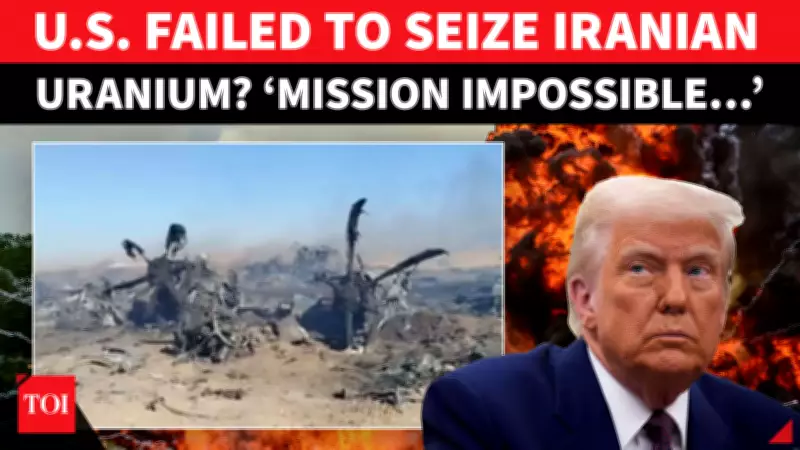
Was the recent US operation in Isfahan a rescue mission or a nuclear heist? President Donald Trump called the April operation one of the most daring rescues in history, but geostrategic analyst Christopher Helali says the wreckage tells a darker story. With two Hercules transports, four helicopters, and an A-10 lost, Helali argues the United States was actually trying to extract enriched uranium from Iran's strategic heartland.
Conflicting Narratives Emerge
The operation, which took place in April 2026, has sparked intense debate. While Trump hailed it as a successful rescue, analysts point to the scale of the mission. The loss of multiple aircraft suggests a larger objective than a simple rescue. Helali, a noted geostrategic analyst, claims that evidence points to an attempt to steal enriched uranium.
Key Evidence: Nuclear Engineer's Passport
One of the most compelling pieces of evidence is the discovery of a nuclear engineer's passport at the scene. This has fueled speculation that the mission involved personnel with nuclear expertise. The presence of such an individual indicates that the operation may have been designed to handle radioactive materials.

Scale of the Raid
The sheer size of the raid has also raised eyebrows. Deploying two Hercules transports, four helicopters, and an A-10 ground-attack aircraft is far beyond what would be needed for a typical rescue. Helali argues that this force was necessary to extract heavy equipment or materials, such as enriched uranium.
Washington's Story vs. Wreckage
The gap between Washington's official account and the physical evidence on the ground continues to grow. While the White House maintains that the mission was a rescue, the wreckage suggests a more complex and risky operation. The loss of multiple aircraft indicates that the mission faced significant resistance and may have been compromised.
As more details emerge, the true nature of the Isfahan operation remains unclear. However, the theory of a nuclear heist is gaining traction among analysts. The discovery of the passport, the scale of the raid, and the conflicting narratives all point to a mission that was far from straightforward.