

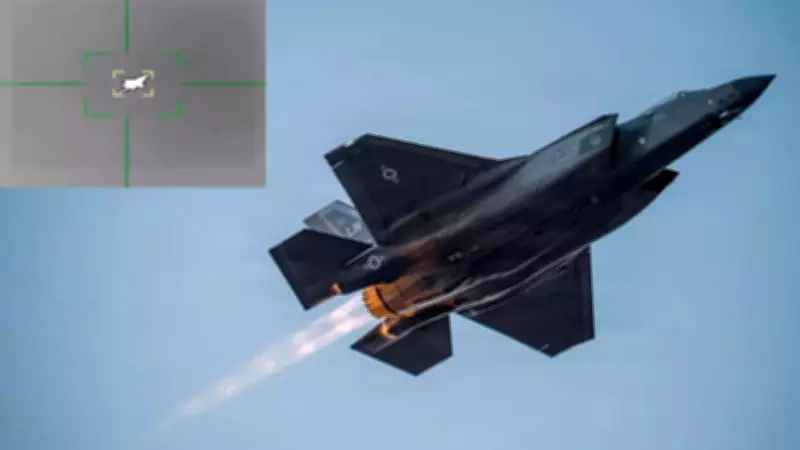
Iran's Infrared Systems Under Scrutiny After Alleged Strike on US F-35 Stealth Jet
Global attention has sharply focused on Iran's claim of successfully striking a US F-35 Lightning II stealth fighter, with preliminary investigations suggesting that infrared-guided air defense systems may have played a crucial role in this unprecedented incident. According to American officials, a US F-35 stealth fighter sustained damage during a combat mission over Iranian airspace and was compelled to execute an emergency landing at a US air base located in the Middle East region.
The pilot survived the engagement and is currently reported to be in stable medical condition. While Washington has not yet provided full confirmation of Tehran's assertions, it has officially acknowledged that the aircraft was indeed struck by what is believed to be Iranian military firepower. Iran has characterized this event as a "world's first hit" against such advanced stealth technology, raising significant questions about how one of the most sophisticated aircraft in modern warfare may have been successfully tracked and targeted.
Infrared Detection Systems: The Potential Game-Changer
Military analysts and defense experts are increasingly examining Iran's infrared-guided surface-to-air defense systems as a probable factor in this engagement. Unlike traditional radar-guided platforms, these infrared systems operate by detecting heat signatures rather than relying on radar emissions, presenting a different challenge for stealth aircraft designed primarily to evade radar detection.

Key Iranian infrared defense systems under consideration include:
- Misagh-2: A locally developed shoulder-fired missile system with an approximate range of 6 kilometers, specifically engineered to lock onto aircraft heat signatures.
- Majid: A newer short-range defense system utilizing electro-optical and infrared tracking technology, designed for point defense against low-flying aerial targets.
- Herz-9: A mobile, passive air defense system capable of tracking targets without emitting detectable radar signals, making it particularly challenging to identify and counter.
- Misagh-1 and Misagh-3: Earlier and upgraded variants within Iran's family of heat-seeking missile systems.
- Sayyad-1A: An enhanced anti-aircraft missile believed to incorporate infrared tracking elements alongside other guidance technologies.
These platforms function passively, meaning they do not broadcast signals that stealth aircraft like the F-35 are specifically engineered to evade. This operational characteristic raises the distinct possibility that infrared detection may have either complemented or entirely substituted traditional radar tracking during this particular military engagement.
Technical Feasibility: Can Infrared Systems Successfully Engage an F-35?
The F-35 Lightning II represents fifth-generation fighter technology, meticulously designed to minimize both radar cross-section and infrared signatures. However, complete invisibility remains technologically unattainable. The aircraft's engine inevitably produces detectable heat, particularly during high-speed maneuvers or intensive combat operations.
Infrared-guided defense systems theoretically possess the capability to exploit this thermal vulnerability through several mechanisms:
- Locking onto engine exhaust heat signatures during critical flight phases
- Tracking aerial targets without emitting radar signals that could alert the aircraft
- Engaging aircraft effectively at short to medium operational ranges
Nevertheless, successfully striking an F-35 remains an exceptionally challenging proposition. The advanced fighter is equipped with sophisticated countermeasure systems including flare dispensers and electronic warfare capabilities. Furthermore, its sensor fusion technology is designed to provide early threat detection through integrated data from multiple sources.
Strategic Implications of the Incident
Captain Tim Hawkins, spokesperson for US Central Command, confirmed that the fifth-generation aircraft was "flying a combat mission over Iran" when it sustained damage requiring emergency landing procedures. "The aircraft landed safely, and the pilot is in stable condition," Hawkins stated officially.

Even a partial strike against such advanced technology carries substantial strategic weight. The F-35 is widely regarded as one of the most survivable aircraft in contested airspace due to its integrated stealth characteristics, advanced sensor fusion capabilities, and network-centric warfare design philosophy.
If Iranian defense systems indeed demonstrated the capability to track and successfully engage the stealth jet, this could indicate several significant developments:
- Substantial improvements in passive detection and tracking technologies
- Effective implementation of layered air defense networks combining multiple system types
- Potential operational vulnerabilities in high-threat environments for even advanced aircraft
Iran has claimed that this strike reflects substantial upgrades to its integrated air defense network, though specific technical details remain undisclosed and unverified through independent sources.
Broader Conflict Context and Future Implications
This reported engagement occurs within an ongoing conflict context where the United States has reportedly lost at least sixteen aircraft, including multiple MQ-9 Reaper drones according to Bloomberg analysis. Other losses have been attributed to various accidents and incidents of friendly fire during complex combat operations.
While US military officials maintain that operations continue according to planned objectives, defense analysts note that only "localized air superiority" has been established in specific portions of Iranian airspace rather than comprehensive dominance.
Against this operational backdrop, Iran's claim of successfully striking an F-35—whether accomplished through infrared systems exclusively or in combination with other tracking methodologies—could potentially signify an important shift in how stealth aircraft are challenged within contemporary warfare environments. This incident may prompt reevaluation of stealth technology assumptions and accelerate development of counter-stealth detection systems globally.





