Israel Launches Pre-Dawn Strikes on Lebanon, Intercepts Iranian Missiles as War Escalates
Israel conducted pre-dawn strikes on Lebanon on Thursday and reported intercepting fresh missiles from Iran, marking a significant expansion of the war initiated by the United States and Israel across the Middle East. This escalation follows a US submarine sinking an Iranian warship in the Indian Ocean and the US Senate voting down a War Powers resolution aimed at limiting President Donald Trump's military campaign, 'Operation Epic Fury', against Iran.
Conflict Enters Sixth Day with Rising Casualties
The conflict entered its sixth day after US and Israeli strikes on Saturday resulted in the death of Iran’s Supreme Leader Ayatollah Ali Khamenei and other key figures, prompting retaliatory actions from Tehran throughout the region. Official reports indicate that more than 1,000 people have been killed in Iran, over 70 in Lebanon, and approximately a dozen in Israel. The US and Israel have stated that their targets include Iran’s leadership, missile arsenal, and nuclear program, with suggestions that toppling the government is an objective. However, inconsistent statements on goals and timelines hint at the potential for an open-ended conflict.
Iran Launches Fresh Missile Attacks and Claims Control of Strait of Hormuz
Iran launched a new round of missiles at Israel early Thursday, triggering alerts in several areas, including Tel Aviv, according to Israeli military and Tehran's state media. No immediate casualties were reported. In retaliation for the initial strikes, Iran has targeted sites across the region, including Bahrain, Kuwait, and Israel. Iran’s elite Revolutionary Guards claimed to have closed the Strait of Hormuz, warning that "The Americans' mischief and deceit could lead to the collapse of the entire military and economic infrastructure of the region." The IRGC asserted on Wednesday that "the Strait of Hormuz is under the complete control of the Islamic Republic's Navy."

In related developments, a ballistic missile launched from Iran towards Turkish airspace via Iraq and Syria was destroyed by NATO air defense systems, as confirmed by Turkish officials. Additionally, the Saudi ministry of defense announced the successful interception and destruction of three cruise missiles outside the city of Al-Kharj.
Airstrikes Hit Hezbollah Stronghold in Beirut
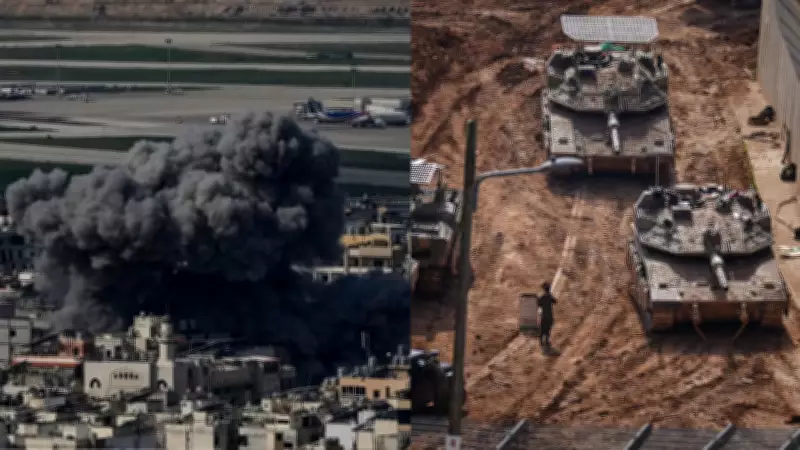
An airstrike struck the Hezbollah stronghold of south Beirut early Thursday, following a warning issued by Israel to residents. Elsewhere, three individuals were killed in a pair of Israeli strikes on vehicles along Beirut's airport highway, according to Lebanon's health ministry. Prior to these incidents, officials reported that 72 people had been killed and more than 83,000 displaced since the resurgence of fighting between Israel and Hezbollah. Israel also engaged in exchanges of fire with the Iranian-backed Hezbollah militant group in Lebanon.
Israel stated that it targeted buildings associated with Iran's Basij, the all-volunteer force of the paramilitary Revolutionary Guard, which was involved in a bloody crackdown on protesters in January that resulted in thousands of deaths.
US Submarine Sinks Iranian Warship in Indian Ocean
A US submarine sank an Iranian warship in the Indian Ocean as Washington and Israel intensified their bombardment of Iran's security forces and other symbols of power. US Defense Secretary Pete Hegseth confirmed that a torpedo from an American submarine sank the vessel on Tuesday night. Sri Lankan authorities reported that 32 people were rescued from the ship, while the country's navy recovered 87 bodies.
The intensity of the strikes on Iran was so severe that state television announced the postponement of the mourning ceremony for Supreme Leader Ayatollah Ali Khamenei, who was killed at the conflict's outset. Millions had attended the funeral of his predecessor, Ayatollah Ruhollah Khomeini, in 1989.

US Senate Backs Trump's Military Action Against Iran
The US Senate voted down a War Powers resolution aimed at limiting President Donald Trump's military action, 'Operation Epic Fury', against Iran. The measure failed with a vote of 47-53, largely along party lines, as reported by Fox News. Only Senator Rand Paul voted in favor of the resolution, while Jon Fetterman was the sole Democrat to cross party lines in support, aiding the GOP in defeating the measure. Democrats argued that Trump's actions disregarded Congress' authority to use military force, lacked a clear strategy, and represented another broken campaign promise.
Polls indicated that eight in 10 Republicans approve of the current US use of force, while nearly eight in 10 Democrats disapprove, and six in 10 independents disapprove. Among military veterans, 59% approve of the US strikes on Iran. President Donald Trump praised the US performance in the war, stating, "We're doing well on the war front, to put it mildly. Somebody said on a scale of 10, where would you rate it? I said about a 15."
Energy Supplies Threatened and Oil Prices Soar
Iran’s paramilitary Revolutionary Guard issued a severe threat, warning that the strikes against it would lead to "the complete destruction of the region’s military and economic infrastructure." Tanker traffic through the Strait of Hormuz has decreased by approximately 90% compared to prewar levels, according to shipping tracker MarineTraffic.com. Oil prices have surged, and global stock markets have suffered due to concerns that rising oil prices could destabilize the world economy.
In a related incident, a tanker anchored off the coast of Kuwait was hit by a "large explosion" on Thursday, causing an oil spill in the Persian Gulf. The British maritime security agency UKMTO reported the incident in the Mubarak Al-Kabeer area. The vessel’s Master heard a loud blast on the port side, after which a small craft was seen departing. The tanker has taken on water but has no fires onboard, and all crew members are safe.
Iran Scrambles to Choose New Supreme Leader
Iran’s leaders are urgently working to replace Khamenei, who ruled for 37 years. This marks only the second time since the 1979 Islamic Revolution that a new supreme leader is being selected. Potential candidates range from hard-liners committed to confrontation with the West to reformists seeking diplomatic engagement. Mojtaba Khamenei, Khamenei’s son, is among the contenders, despite never holding an elected or appointed government position.
In a move indicating consolidation of power amid the crisis, the head of Iran’s judiciary warned that "those who cooperate with the enemy in any way will be considered an enemy." Israel's defense minister, Katz, stated on X that Iran's next supreme leader, if he continues to threaten Israel, the US, and others, "will be a target for elimination."
Diplomatic Reactions and Mediation Efforts Intensify
Spain reinforced its opposition to Washington's use of its bases against Iran, despite Trump's threats of trade reprisals. The White House claimed Madrid had agreed to cooperate, but Spanish foreign minister Jose Manuel Albares clarified that its stance on "bases, on the war in the Middle East, on the bombardment of Iran, has not changed at all."
China announced it will send a special envoy to mediate in the Middle East, as stated by foreign minister Wang Yi. Beijing, a close partner of Iran, supports Tehran in defending its sovereignty while urging the United States and Israel to cease their attacks.