

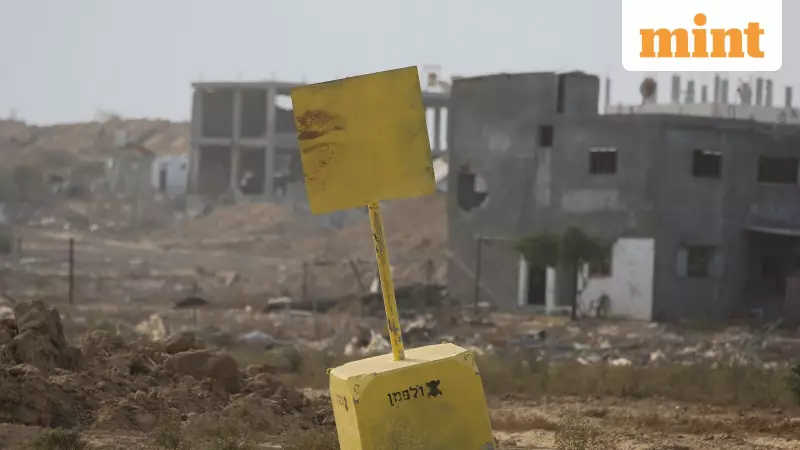
Amidst deep uncertainty surrounding the durability of a fragile ceasefire in Gaza, Israel delivered a significant statement on Sunday, indicating it would not retreat beyond a strategic demarcation known as the Yellow Line, which it now terms a "new border."
What is the Yellow Line in Gaza?
The announcement came directly from the Israeli military, with army chief Lieutenant General Eyal Zamir making the declaration. He asserted that Israeli forces have operational control over large sections of the Gaza Strip and plan to maintain their positions. "The Yellow Line is a new border line -- serving as a forward defensive line for our communities and a line of operational activity," Zamir stated, according to a report from the AFP news agency.
This Yellow Line was established under the ceasefire agreement brokered by former US President Donald Trump between Israel and Hamas. The terms required the Israeli Defence Forces (IDF) to pull back to positions behind this line. The territory east of the Yellow Line, which remains under Israeli control, constitutes between 53% and 58% of the total area of the Gaza Strip. Officially, the status of this line is temporary, acting as a de facto military boundary within the Palestinian enclave.

The Phased Withdrawal Plan and Next Steps
The broader peace plan envisions subsequent phases where Israel would undertake further withdrawals. The later stages involve the eventual deployment of an International Stabilization Force (ISF). According to the plan, Israel's territorial hold in Gaza is expected to shrink to 40% after the second withdrawal, and eventually down to just 15% following a third pullback.
Lieutenant General Zamir's firm statement follows closely on the heels of Israeli Prime Minister Benjamin Netanyahu signalling a potential move towards the second phase of the ceasefire. During a recent news conference with visiting German Chancellor Friedrich Merz, Netanyahu indicated that Tel Aviv and Hamas were "very shortly expected to move into the second phase of the ceasefire." However, he set a clear precondition: this advancement would only occur after the Palestinian militant group returns the remains of the last known Israeli hostage.
The Hostage Impasse Blocking Progress
The key obstacle currently is the handover of the remains of 24-year-old Ran Gvili, a police officer killed during the 7 October attack in 2023. Hamas has not yet returned his body. The completion of this exchange—Gvili's remains for Israel's return of 15 bodies of Palestinians—is stipulated as the final step to conclude the first phase of Trump's 20-point truce plan for Gaza. Until this occurs, the fragile peace process remains in a state of suspended animation, with Israel digging in at its newly declared border.
The situation leaves the region at a critical juncture, with Israel's new defensive posture potentially reshaping the geopolitical reality on the ground, even as diplomatic efforts strive to navigate the next steps of a highly complex and sensitive ceasefire agreement.






