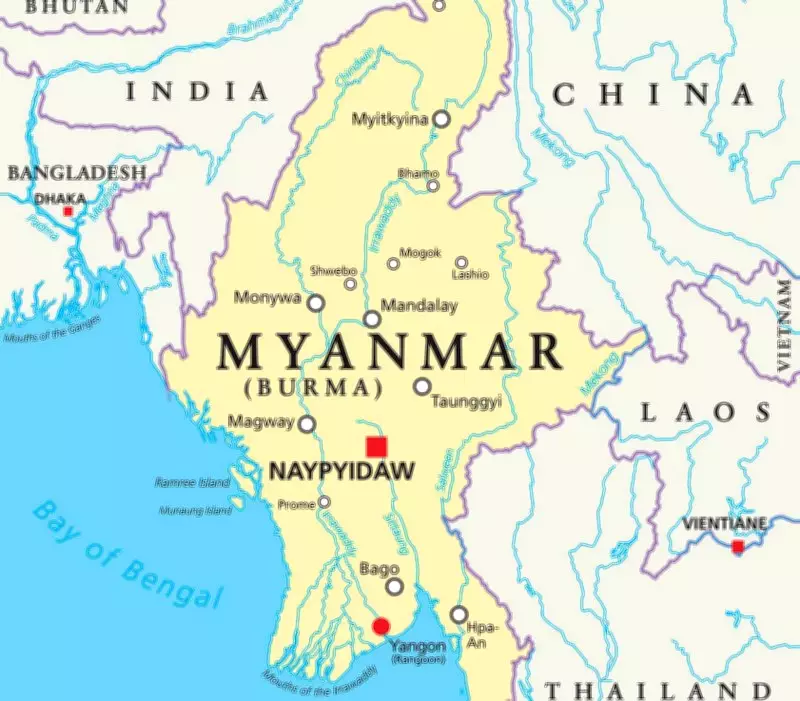
According to the Narcotics Control Bureau (NCB), Myanmar's illicit opium cultivation expanded significantly between 2021 and 2023, growing from 30,200 to 47,100 hectares. This expansion has positioned Myanmar as the primary substitute supply zone, filling the global gap left by Afghanistan's market collapse. The Northeastern states of Manipur, Mizoram, and Nagaland are facing acute frontline exposure to this surge in illicit drug production from Myanmar. Historically viewed as peripheral transit zones, these states have emerged as active staging grounds for distribution of narcotics.
Porous Borders and Free Movement Regime
This shift is primarily driven by porous border mechanisms, including the Free Movement Regime (FMR) along the 1,643-km heavily-forested India-Myanmar border. Official sources point to India's eastern borders as the most direct and vulnerable entry points for this expanding production base. This can be gauged from the 140 per cent increase in Amphetamine-Type Stimulant (ATS) seizures in India between 2020 and 2025 — culminating in a record 8.2 tonnes seized in 2024 alone. Concurrently, methamphetamine (yaba) flows from Myanmar through this corridor continue to intensify, mirroring the broader global expansion documented in the UNODC (United Nations Office on Drugs and Crime) 2025 report.
Major Trafficking Pipeline via Mizoram
A major trafficking pipeline enters India through Champhai in Mizoram, which shares close geographic and cultural proximity with Myanmar's Chin State. Contraband is smuggled through unfenced and porous border stretches. It is systematically routed towards Silchar in Assam's Barak valley through Aizawl and adjoining road networks. Thereafter, the contraband moves towards Meghalaya to reach Guwahati, from where it is distributed across mainland India.

During 2025, Indian drug law enforcement agencies registered an all-time high of over 1.48 lakh cases, seizing more than 1,200 tonnes of narcotic drugs and psychotropic substances. According to NCB Director General Anurag Garg, the scale and diversity of these seizures — spanning plant-based narcotics, synthetic substances, pharmaceutical diversions, and precursor chemicals — underscore an increasingly complex and evolving national security challenge. The NCB also dismantled 30 clandestine methamphetamine and mephedrone laboratories in 2025, a figure surpassing the previous three years combined.
Western Frontier Pressures
The 3,323-km India-Pakistan border presents a persistent challenge due to its proximity to Afghanistan, historically the world's dominant opium producer. Despite the 2022 Taliban drug ban, which slashed Afghan opium production by 93 per cent from its peak, the UNODC notes that existing stockpiles remain sufficient to meet global demand through 2026. Punjab, Rajasthan, and the Union Territory of Jammu and Kashmir remain highly vulnerable to this trans-border trafficking. The nationwide heroin seizure during 2025 was 3,567 kg, of which Punjab's share was 2,086 kg or 58 per cent.
Three Critical Points of Caution
The NCB report emphasises that a drop in Afghan opium cultivation does not equate to a diminishing threat. Firstly, it says that the volume decline is a supply-side phenomenon and not a demand-side one. Existing stockpiles have continued to sustain trafficking flows even as production has fallen. Further, these pipelines are being used to traffic ATS in the region. Secondly, trafficking networks have not abandoned the western corridor. Rather, they have adapted to the new situation through drone technology. Thirdly and most significantly, the collapse of the Afghan supply has not eliminated the Golden Crescent as a geopolitical risk. Syndicates that historically depended on Afghan-origin heroin are now diversifying their products and some of it is flowing eastward into India, the NCB report has highlighted.

Vulnerable Regions and Emerging Challenges
The Golden Triangle continues to be a major source of methamphetamine entering through India's northeastern states. Additionally, 2025 saw a sharp rise in emerging challenges like hydroponic cannabis, mephedrone, darknet marketplaces, and cryptocurrency-funded transactions. While cannabis remained the most frequently seized narcotic drug overall in 2025, ATS saw massive spikes. Mizoram accounted for the seizure of 1,477 kg of ATS, 42 per cent of the total national seizure of 3,269 kg. Other significant contributors were Manipur (535 kg), Delhi (454 kg), Gujarat (308 kg) and Karnataka (164 kg).