

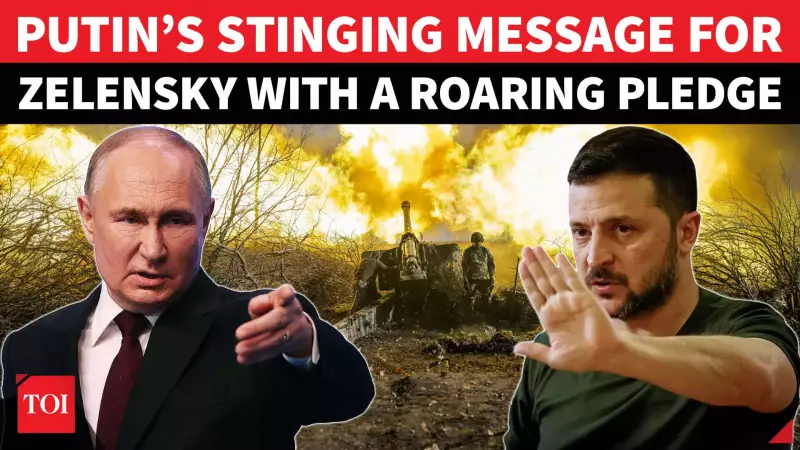
In a sharply worded address that has escalated rhetorical hostilities, Russian President Vladimir Putin has launched a fresh verbal assault on Ukrainian leadership. He directly accused President Volodymyr Zelensky of deviating from a promised peace path and now operating under the sway of radical nationalist factions.
Putin's Fiery Allegations Against Kyiv's Leadership
During his statement on December 5, 2025, Putin did not mince words. He likened the current approach of the Ukrainian government to a 'neo-Nazi mindset'. The Russian leader argued that the priorities in Kyiv have dangerously shifted. According to him, the focus is no longer on the broader Ukrainian population but has been hijacked by a narrow ideological circle with extremist views.
Putin claimed that Zelensky has abandoned the commitments to peace that were once part of his platform. Instead, the Ukrainian president is now allegedly being influenced by groups with a radical nationalist agenda. This, Putin asserted, is a primary obstacle to ending the ongoing conflict.

The Call for Diplomacy and Reference to Failed Talks
The Russian President emphasised that diplomacy remains the only viable solution to the war that has ravaged the region. He pointedly referenced the peace negotiations that were attempted back in 2022, suggesting that those efforts failed due to Kyiv's choices.
Putin insisted that the conflict continues to persist not because of a lack of opportunity for dialogue, but because the Ukrainian leadership consistently chooses military escalation over sitting at the negotiation table. He urged future decisions to be made with the interests of the wider Ukrainian people in mind, rather than catering to what he termed 'nationalist agendas'.
Implications for the Ongoing Conflict
This latest statement from Moscow is seen as a hardening of Russia's official narrative, framing the war as a struggle against 'neo-Nazi' elements rather than a conflict with the Ukrainian state or its people. It effectively dismisses the Ukrainian government as illegitimate proxies of radicalism.
Analysts suggest such rhetoric is aimed at justifying Russia's military actions domestically and internationally, while also potentially undermining Western support for Zelensky's administration. By labelling the regime with the highly charged term 'neo-Nazi', Putin seeks to draw historical parallels and moral justification for Russia's stance.
The call for diplomacy, while repeated, comes alongside accusations that make the prospect of immediate talks seem remote. The insistence that Kyiv must first realign its priorities with the people's interests, as defined by Moscow, sets a contentious precondition for any future negotiations.






