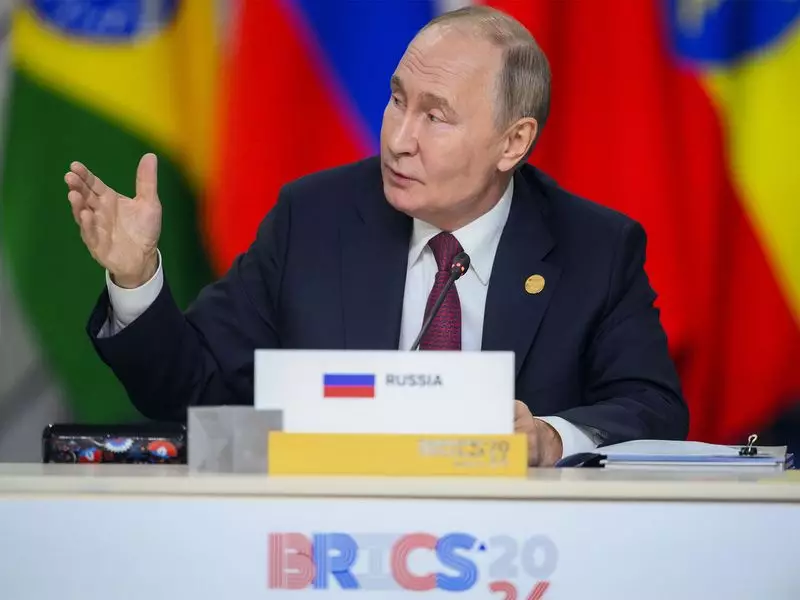
In a stark escalation of rhetoric, Russian President Vladimir Putin has declared that Moscow will be compelled to capture more Ukrainian land if ongoing attempts to broker a peace deal ultimately fail. This direct warning, delivered during a high-profile meeting with senior diplomats, underscores the Kremlin's hardening stance and casts a long shadow over fragile international efforts to end the devastating conflict.
The Core Demands: A Non-Negotiable Stance
President Putin laid out a series of conditions that he described as fundamental for any potential ceasefire or peace agreement. Central to his demands is the complete withdrawal of Ukrainian military forces from four regions that Russia claims to have annexed in 2022: Donetsk, Luhansk, Kherson, and Zaporizhzhia. Moscow insists that Kyiv must recognise these territories as part of Russia, a precondition that Ukraine and its Western allies have repeatedly and categorically rejected.
Furthermore, Putin demanded that Ukraine abandon its ambition to join the NATO military alliance, framing it as a critical security requirement for Russia. "The conditions are very simple," Putin stated, outlining what he called a "final resolution" rather than a temporary freeze in fighting. He warned that if Kyiv and the West refuse these terms, the consequences would be severe. "In the end, if they don't want to (negotiate), then we will be forced to take additional measures... which could include the creation of a certain 'sanitary zone' in Ukrainian territory," he declared, using a euphemism often interpreted as a buffer zone under Russian control.

Context and Timing: A Strategic Warning
This forceful statement comes at a critical juncture, just ahead of a major peace summit scheduled to be held in Switzerland on June 15-16. Notably, Russia has not been invited to participate in this Swiss-led conference. By publicly stating his maximalist demands now, Putin is widely seen as attempting to undermine the summit's legitimacy and pressure Ukraine's allies to push Kyiv towards concessions.
The Russian leader's remarks also follow significant military developments on the ground. Ukrainian forces have faced recent setbacks, struggling with shortages of ammunition and air defence systems. Putin's warning appears designed to capitalise on this perceived moment of Ukrainian vulnerability, presenting his terms as an ultimatum rather than an opening for negotiation.
Global Repercussions and the Path Ahead
The international reaction to Putin's warning has been one of firm rejection and concern. Western leaders have consistently maintained that any peace must respect Ukraine's sovereignty and territorial integrity within its internationally recognised borders. The demand for Ukraine to cede nearly a fifth of its territory is viewed as a non-starter, effectively rewarding Russian aggression.
Analysts suggest that Putin's speech signals a prolonged and potentially more expansive conflict. The threat of creating a "sanitary zone" raises the alarming prospect of Russian forces pushing deeper into Ukrainian territory, possibly aiming to capture the key port city of Odesa or more land along the Black Sea coast. This move would further cripple Ukraine's economy and strategic position.
The ball is now effectively in the court of Ukraine and its international partners. The upcoming summit in Switzerland will be a crucial test of Western unity and resolve. Key questions remain:
- Can Ukraine's allies provide the sustained military support needed to alter the battlefield calculus?
- Is there any diplomatic space for a compromise that doesn't legitimise territorial conquest?
- How will the global South, including nations like India, respond to this latest escalation and the stalled peace process?
Putin's unambiguous warning has sharply defined the stakes. The failure of diplomacy, as framed by the Kremlin, would not mean a return to the status quo but an escalation with dire consequences for European security and the international order. The world now watches to see if this is a genuine, if harsh, roadmap to peace or merely a justification for a protracted and bloodier war.