

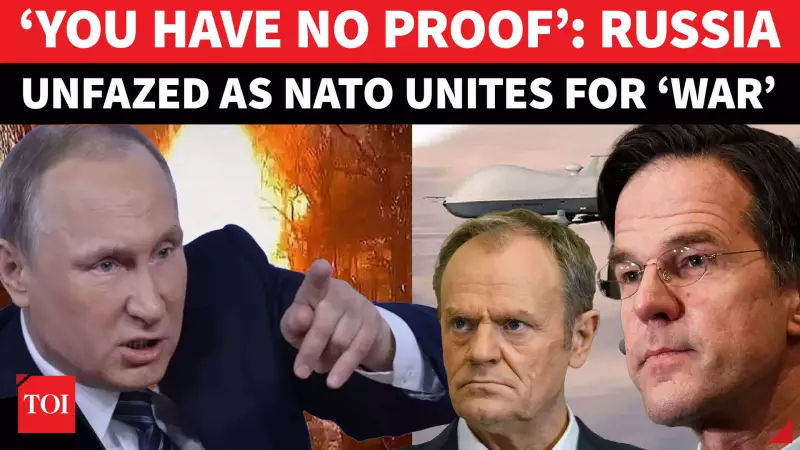
Moscow has issued a firm rebuttal to accusations from Warsaw that Russian drones entered NATO airspace, labeling the claims as politically driven and lacking any concrete evidence. The diplomatic spat, which prompted Poland to invoke a key NATO consultation clause, underscores the heightened risk of direct confrontation between the military alliance and Russia amid the ongoing war in Ukraine.
Poland Invokes NATO Article 4, Moscow Demands Proof
The controversy erupted after Polish Prime Minister Donald Tusk initiated consultations under NATO's Article 4, a measure taken when a member state feels its territorial integrity or security is threatened. The move followed reports of unidentified drones violating Polish airspace, which Polish authorities linked to Russian operations.
However, the Russian embassy in Warsaw swiftly countered, stating that Poland had presented "no evidence" of Russian involvement. The Kremlin echoed this sentiment, with spokesperson Dmitry Peskov accusing NATO and the European Union of engaging in what he called "daily provocations" based on allegations rather than proof.

The Blame Game and Conflicting Theories
While European leaders, including those from Germany, insisted the drones were deliberately directed, alternative explanations emerged from Moscow's ally. Belarus suggested that the incident might have been caused by electronic warfare systems, potentially causing drones to stray off course accidentally.
This conflicting narrative has intensified the blame game, with each side holding its ground. The European stance remains firm on intentional aggression, while Russia and its partners dismiss the event as either fabricated or a technical mishap.
Escalating Tensions on NATO's Eastern Flank
Analysts view this incident as a dangerous flashpoint, highlighting how the conflict in Ukraine is increasing friction along NATO's borders. The invocation of Article 4 is a serious diplomatic step, indicating the level of concern in Warsaw. It sets the stage for heightened military alertness and coordinated alliance responses, bringing the specter of a wider conflict closer to reality.
The standoff, reported on December 8, 2025, serves as a stark reminder of the fragile security environment in Eastern Europe. With trust at an all-time low and communications fraught, such incidents risk rapid escalation without clear channels for de-escalation.






