

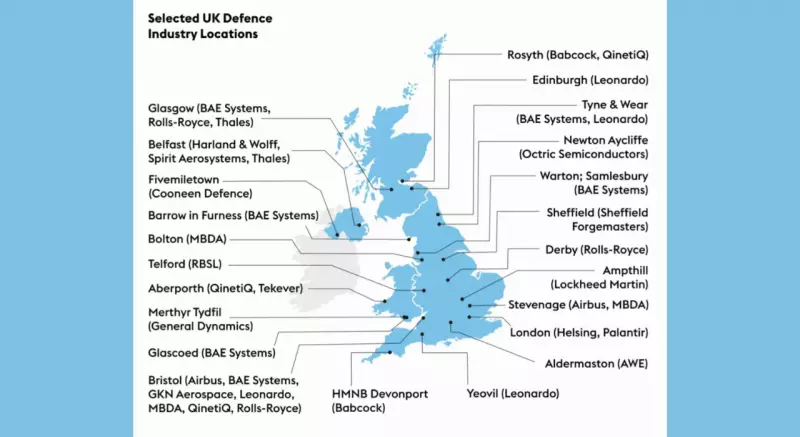
In a stark reminder of escalating global tensions, a provocative 2019 Russian state television segment detailing potential US nuclear targets has recirculated online. This comes alongside the recent release of a comparable map targeting key UK defence and industrial sites, pointing to a sustained pattern of strategic messaging from Moscow-linked figures.
The 2019 Broadcast: A Direct Warning to America
On Sunday, 24 February 2019, the flagship weekly news programme Vesti Nedeli aired a segment that captured international attention. Presented by Dmitry Kiselyov, a top Kremlin media figure, the broadcast featured a map of the United States marked with locations described as "presidential or military command centres."
Kiselyov named specific sites including the Pentagon and Camp David, the presidential retreat in Maryland. He claimed Russia's then-developing Tsirkon hypersonic missile could strike such targets in under five minutes if launched from submarines near US waters. The map also included decommissioned sites like Fort Ritchie and McClellan Air Force Base, a detail analysts noted at the time.

"For now, we’re not threatening anyone," Kiselyov told viewers, before adding a stark caveat: "But if such a deployment takes place, our response will be instant." The broadcast followed President Vladimir Putin's warning of a potential "Cuban missile-style" crisis, issued amid the collapse of the Cold War-era Intermediate-Range Nuclear Forces (INF) Treaty.
Why the Old Map is Trending Again in 2025
The 2019 footage regained prominence in autumn 2025 after Russian figures began circulating lists of alleged UK targets. The immediate trigger was a Telegram post by Dmitry Rogozin, a former deputy prime minister and ex-head of Roscosmos, now a senator from Russian-occupied Zaporizhzhia.
Rogozin published a map identifying 23 locations across the UK, labelled as defence industry sites, nuclear infrastructure, and military facilities. He framed it as a response to statements from British figures, notably former UK Defence Secretary Ben Wallace, who had suggested making Crimea "uninhabitable" for Russian forces.
"What a sober minister has in mind, a former one has on his tongue," Rogozin wrote, adding a warning to Russian oligarchs: "Do not send your children to study in England. It is deadly dangerous." The listed UK sites, from Glasgow's BAE Systems to Aldermaston's Atomic Weapons Establishment, closely match locations in the UK government's own Defence Industrial Strategy 2025 document.
NATO's Response and the Bigger Picture
This resurgence of threatening maps occurs against a backdrop of fresh warnings from NATO leadership. NATO Secretary General Mark Rutte recently stated, "We are Russia’s next target, and we are already in harm’s way." He urged member states to rapidly increase defence spending and production, cautioning that time is not on their side.
Analysts interpret these television segments and map releases not as literal strike plans, but as a form of political communication and strategic signalling. The intent is to underscore Russia's advanced weapons capabilities, like hypersonic missiles and the Poseidon nuclear drone, and to test Western resolve during periods of heightened tension.
The UK's status as a core NATO member means any direct attack would trigger Article 5, the alliance's collective defence clause. This fundamental reality continues to shape how such overt threats from Russian state media are perceived beyond their primary domestic audience, framing them as tools of psychological and diplomatic pressure in a deteriorating security environment.






