

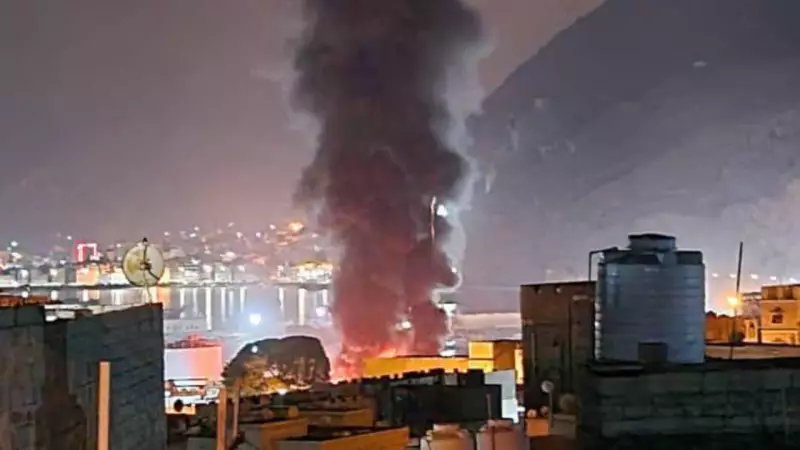
Forces opposing Yemen's Houthi rebels declared a state of emergency on Tuesday, a dramatic move triggered by a series of Saudi Arabian airstrikes on the strategic port city of Mukalla. The Saudi-led coalition stated the strikes were aimed at destroying an illicit shipment of weapons destined for separatist forces backed by its ally, the United Arab Emirates (UAE).
Pact Cancelled and Borders Sealed
In a swift and significant retaliation, the anti-Houthi authorities officially cancelled a key security agreement with the UAE. An official statement announced, "The Joint Defence Agreement with the United Arab Emirates is hereby cancelled." Furthermore, all border crossings were ordered closed for a strict 72-hour period following the attack.
The Saudi military, in a statement published by the state-run Saudi Press Agency, provided its justification. It claimed the overnight strikes targeted armoured vehicles and weapons that had been unloaded from ships in Mukalla. These vessels, according to Riyadh, had arrived from Fujairah in the UAE after deliberately disabling their tracking systems.

The military equipment was allegedly intended for the Southern Transitional Council (STC), a powerful separatist group that seeks an independent southern Yemen and is a primary proxy for the UAE in the complex conflict. The coalition described the weapons cache as an "imminent threat" to peace and stability, insisting the operation was a limited and precise action to avoid civilian harm.
Growing Friction Between Gulf Allies
Regional analysts were quick to highlight that the military action lays bare the deepening friction between Saudi Arabia and the UAE. Although both nations are formal allies and part of the coalition opposing the Iran-aligned Houthis, they have long supported rival factions on the ground in Yemen's decade-long war.
Satellite tracking data appears to corroborate parts of the Saudi claim. It showed that at least one suspected vessel was docked in Fujairah on December 22 before making its way to Mukalla, where it arrived on Sunday, just before the strikes.
Mukalla is located in Yemen's Hadramout governorate, roughly 480 kilometres northeast of Aden, the temporary capital of Yemen's internationally recognised government, which is backed by Saudi Arabia. The STC has been aggressively expanding its influence in Hadramout and the neighbouring Mahra governorate, recently pushing out forces loyal to the Saudi-supported National Shield Forces.
A Warning and Wider Regional Instability
Tuesday's bombardment follows similar airstrikes carried out by the coalition last Friday. Experts interpret these consecutive actions as a clear warning from Saudi Arabia to the STC to halt its military advances in eastern Yemen. The separatists have intensified their campaign, with supporters openly flying the flag of the former South Yemen, a state that existed until unification in 1990.
This escalation in Yemen occurs against a backdrop of broader instability across the Red Sea region. The strategic rivalry between Riyadh and Abu Dhabi is also playing out in Sudan's civil war, where they again back opposing sides. Furthermore, tensions have been heightened by Israel's recent recognition of Somaliland, a breakaway region of Somalia, a move that provoked threats from Yemen's Houthi rebels.
The situation in eastern Yemen remains highly volatile. The incident in Mukalla demonstrates how regional power competitions are increasingly complicating and prolonging efforts to find stability for the war-torn nation.






