

US Missile Inventories Severely Depleted Following Iran Conflict, Report Warns
A new analysis has raised significant concerns about the United States' military readiness, revealing that the country's stockpiles of several critical missile systems have been sharply reduced during the ongoing war with Iran. According to defense analysts and sources familiar with recent Pentagon assessments, this depletion could severely impact America's ability to sustain another major conflict in the coming years.
Substantial Expenditure of Key Missile Systems
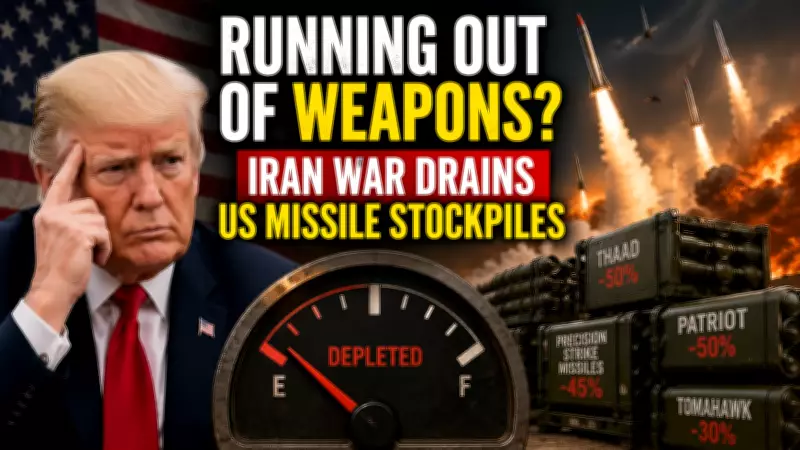
The comprehensive analysis conducted by the Center for Strategic and International Studies presents alarming figures regarding munitions expenditure. During just seven weeks of intense fighting, the US military has utilized at least 45% of its inventory of Precision Strike Missiles, approximately half of its THAAD interceptors, and nearly 50% of Patriot air defense missiles. These numbers broadly align with classified US stockpile assessments according to sources familiar with internal Pentagon data who spoke with CNN.
The report further estimates that the United States has expended around 30% of its Tomahawk missile stockpile, more than 20% of long-range Joint Air-to-Surface Standoff Missiles, and approximately 20% of its SM-3 and SM-6 missiles. These systems represent crucial components of America's advanced military arsenal, and replacing many of them could require four to five years according to the study's projections.

Vulnerability Window in Western Pacific
While the report indicates that the US likely still possesses sufficient weapons to continue combat operations against Iran if the current ceasefire collapses, it issues a stark warning about remaining inventories being insufficient for a separate conflict against a near-peer adversary such as China. The analysis specifically highlights how the high munitions expenditures have created what it terms "a window of increased vulnerability in the western Pacific."
Mark Cancian, a retired US Marine Corps colonel and one of the report's authors, emphasized the timeline challenges in an interview with CNN. "It will take one to four years to replenish these inventories and several years after that to expand them to where they need to be," Cancian stated, underscoring the strategic implications of the current depletion.
Contrasting Official Statements and Congressional Concerns
The report's findings stand in contrast to recent comments by former President Donald Trump, who denied any shortage of US weapons while simultaneously requesting additional funding for missile procurement. "We're asking for a lot of reasons, beyond even what we're talking about in Iran," Trump said last month. "Munitions in particular, at the high end we have a lot, but we're preserving it."
In an official statement to CNN, chief Pentagon spokesman Sean Parnell maintained that the military "has everything it needs to execute at the time and place of the President's choosing." Parnell further noted that since President Trump took office, the military has executed multiple successful operations while ensuring a deep arsenal of capabilities to protect American interests.
However, concern has surfaced in Congress regarding these developments. Arizona Democratic Senator Mark Kelly expressed apprehension last month, stating, "The Iranians do have the ability to make a lot of Shahed drones, ballistic missiles, medium range, short range and they've got a huge stockpile." Kelly posed the critical question: "So at some point ... this becomes a math problem and how can we resupply air defense munitions. Where are they going to come from?"
Broader Implications for Military Aid and Production Challenges
The report warns that shrinking stockpiles could significantly affect future military aid to Ukraine and support for allies that rely on US-made missile systems. This concern echoes previous warnings from military leaders, including Joint Chiefs of Staff Chairman Gen. Dan Caine, who had cautioned the White House before the war began that a prolonged campaign could strain weapons inventories, particularly those also used to support Israel and Ukraine.

Earlier this year, the US Department of Defense signed contracts aimed at expanding missile production capacity. However, analysts note that delivery timelines remain lengthy due to earlier under-ordering and persistent industrial bottlenecks. The combination of high wartime expenditure and production constraints creates a challenging scenario for military planners seeking to maintain America's strategic edge in an increasingly complex global security environment.





