

US Military Escalates Air Campaign Against Iran with Advanced Fighter Jets
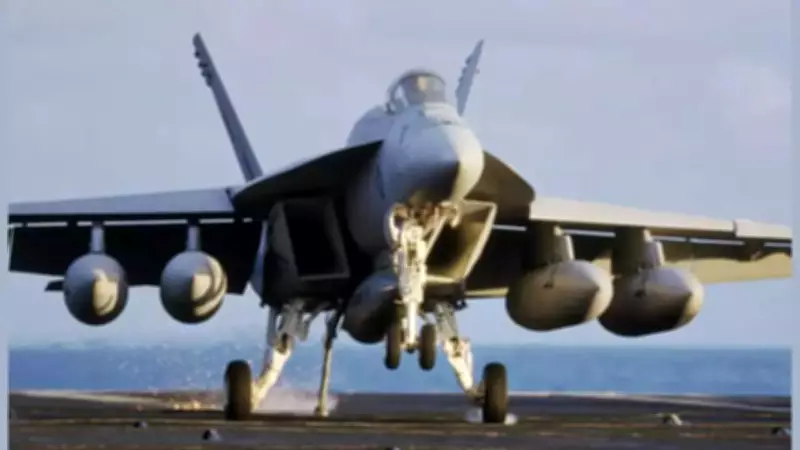
The United States military has significantly intensified its aerial operations against Iran as part of Operation Epic Fury, an ongoing air campaign targeting Iranian military infrastructure. This escalation involves a wide array of advanced aircraft, including F/A-18E Super Hornets and F-35C Lightning II fighter jets, operating from the aircraft carrier USS Abraham Lincoln (CVN-72) in the Arabian Sea.
Operation Epic Fury: A Multi-Platform Assault
According to the United States Central Command (CENTCOM), the US military is utilizing a diverse fleet of aircraft in this campaign. This includes stealth bombers like the B-2 Spirit and fighter jets such as the F-15 Eagle, F-16 Fighting Falcon, F-22 Raptor, and the Navy's F/A-18 Super Hornet. Many of these naval aircraft are launching from aircraft carriers deployed in the CENTCOM region, notably the USS Gerald R. Ford and the USS Abraham Lincoln.
Video footage released online shows F/A-18E Super Hornets and F-35C Lightning IIs assigned to Carrier Air Wing Nine (CVW-9) conducting both daytime and nighttime flight operations aboard the USS Abraham Lincoln on March 12, 2026. The carrier was positioned in the Arabian Sea during these operations, as confirmed by US military sources.

US officials report that these aircraft, along with ground-based assets across the region, have struck thousands of Iranian targets, including several ships. CENTCOM also disclosed that a B-52H Stratofortress bomber recently embarked on a night mission under Operation Epic Fury, aimed at "eliminating threats" posed by the Iranian regime and preventing the country from rebuilding its military capabilities. The command emphasized that US strikes remain "unpredictable, dynamic, and decisive."
F/A-18E Super Hornet: The Backbone of Naval Aviation
The F/A-18E/F Super Hornet continues to be one of the most widely used multirole fighters in the United States Navy, forming the core of its carrier air wings. National security analyst Steve Balestrieri recently described the aircraft as the centerpiece of the Navy's strike packages during Operation Epic Fury.
Entering operational service in 1999, the Super Hornet replaced the earlier McDonnell Douglas F/A-18 Hornet design. This twin-engine supersonic multirole fighter is capable of performing both air-to-air and air-to-ground missions, as indicated by its "F/A" designation. It is powered by two General Electric F414‑GE‑400 turbofan engines, designed for rapid maintenance—a four-person crew can remove them in about 20 minutes.
The Boeing F/A-18E/F Super Hornet is equipped to carry an extensive arsenal of weapons. For air-to-air combat, it can deploy missiles such as the AIM-120 AMRAAM, AIM-9 Sidewinder, and AIM-7 Sparrow. For strike operations, it utilizes missiles like the AGM-65 Maverick, AGM-84H/K SLAM-ER, AGM-88 HARM, AGM-158 JASSM, and the AGM-154 Joint Standoff Weapon, targeting ground assets, radar systems, and fortified infrastructure. Additionally, it can carry various bombs, including Joint Direct Attack Munition precision-guided bombs, Paveway series laser-guided bombs, and Mark 80 series bombs.
F-35C Lightning II: Stealth and Network-Centric Warfare
The F-35C Lightning II represents a new generation of fighter aircraft, emphasizing stealth, real-time intelligence sharing, and precision strike capability. Military analysts often describe it as a platform built for network-centric warfare, capable of gathering, processing, and sharing battlefield data with allied forces across air, land, sea, space, and cyber domains.
Thanks to its advanced sensors and data-fusion systems, the F-35 can detect threats earlier, engage targets faster, and coordinate with other forces, making it a crucial component of modern US air operations. Its integration into Operation Epic Fury enhances the campaign's effectiveness and technological edge.
B-52 Stratofortress: Enduring Strategic Bomber
The B-52H Stratofortress has served as a central pillar of the US strategic bomber fleet for over six decades. Capable of flying at altitudes up to 50,000 feet, this bomber can conduct various mission types, including strategic attack, close-air support, air interdiction, and maritime operations.

It can carry a wide range of weapons, such as gravity bombs, cluster munitions, precision-guided missiles, and Joint Direct Attack Munitions (JDAMs). Modern upgrades have equipped the aircraft with electro-optical sensors, forward-looking infrared systems, and advanced targeting pods, enabling accurate strikes even in poor weather or low-visibility conditions.
With aerial refueling, the bomber's range is limited mainly by crew endurance, while its unrefueled combat range exceeds 8,800 miles (14,080 kilometers). The US Air Force expects the B-52 to remain in service until at least 2050, highlighting its continued importance in American military strategy and its role in operations like Epic Fury.
This intensified air campaign underscores the US military's commitment to countering Iranian threats and maintaining regional stability through advanced aerial capabilities and coordinated strikes.





