US Conducts High-Profile Strike on Iranian Missile Sites Near Strategic Strait
The United States executed a significant military operation on Tuesday, targeting Iranian missile facilities located near the critical Strait of Hormuz. This action involved the deployment of some of the most powerful conventional bombs in the American arsenal, specifically designed to penetrate and destroy hardened underground structures.
Details of the Attack and Weaponry Used
According to a statement from US Central Command (CENTCOM) posted on X, US forces successfully employed multiple 5,000-pound deep penetrator munitions against hardened Iranian missile sites along Iran's coastline. The strike aimed at underground facilities that housed Iranian anti-ship cruise missiles, which CENTCOM identified as posing a substantial threat to international shipping in the vital waterway.
The Strait of Hormuz is a crucial maritime chokepoint, through which nearly one-fifth of the world's oil supply passes. At the time of the attack, Iran had effectively blocked the strait using a combination of mines, drones, and ships, heightening regional tensions.

GBU-72 Advanced 5K Penetrator: A Modern Bunker Buster
The bombs utilized in this strike were the GBU-72 Advanced 5K Penetrator, a weapon first deployed in 2021. This bomb represents a modern evolution of earlier bunker-busting designs like the GBU-28. It is engineered specifically to penetrate reinforced concrete or deep underground bunkers before detonating, thereby maximizing destruction to strategic targets while minimizing collateral damage above ground.
Each GBU-72 bomb reportedly costs around $288,000, making it a high-cost weapon. However, it is less powerful than the 30,000-pound GBU-57 Massive Ordnance Penetrator, which has been used in previous US strikes on Iranian nuclear sites.
Extensive Testing and Development
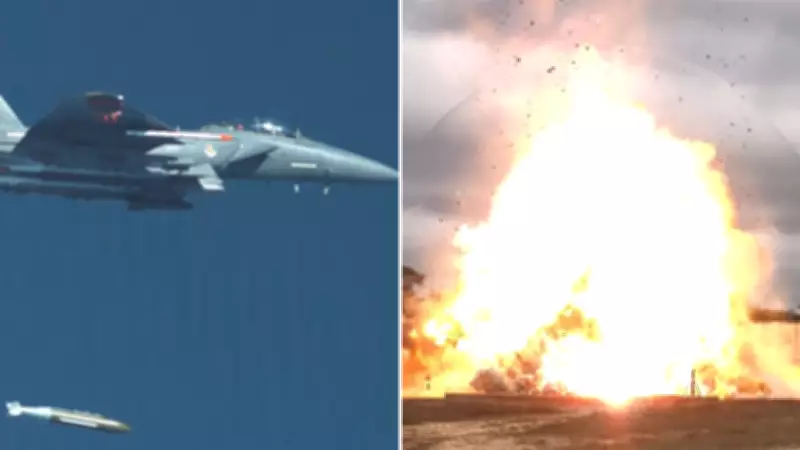
The GBU-72 has undergone rigorous testing to ensure its effectiveness and safety. In October 2021, an F-15E Strike Eagle released a GBU-72 from an altitude of 35,000 feet over Eglin Air Force Base in Florida. This test series, planned by the 780th Test Squadron and flown by the 40th Flight Test Squadron, marked the first-ever flight, load, and release of the 5,000-pound weapon.
These trials validated a modified tail kit originally designed for a 2,000-pound bomb, confirming that the GBU-72 could be safely deployed from various fighter and bomber aircraft. Ground tests at Eglin Air Force Base involved the largest open-air detonation ever conducted at the range, with the warhead surrounded by blast sensors and fragment-counting equipment to assess lethality.
Ronald Forch, a programming engineer with the 780th Test Squadron, emphasized the collaborative effort behind such tests, stating, "Test series of this magnitude are never successful because of a single person or organisation. They are ultimately successful because every part performs in concert, like a symphony."
Escalating Middle East Crisis
The US strike occurred against a backdrop of rising tensions across the Middle East. Iranian forces have threatened retaliation following the killing of security chief Ali Larijani in a separate Israeli air strike. Iranian army chief Amir Hatami warned of a "decisive and regrettable" response, while the Revolutionary Guards launched missiles at central Israel in retaliation.
Simultaneously, Gulf nations have been actively intercepting multiple drone and missile attacks. Saudi Arabia reported intercepting a ballistic missile and eight drones, Kuwait defended against a rocket and drone attack, and Qatar reported an intercepted missile near Doha. Additionally, Australia confirmed that an Iranian projectile landed near its regional military headquarters in the United Arab Emirates.
Strategic Implications and Regional Impact
This strike underscores the ongoing volatility in the Middle East and the US commitment to countering threats to international shipping lanes. The use of advanced bunker-buster bombs highlights the technological edge in modern warfare, aimed at neutralizing deeply buried targets with precision. As tensions continue to simmer, the global community watches closely, with concerns over potential further escalations and their impact on oil markets and regional stability.