

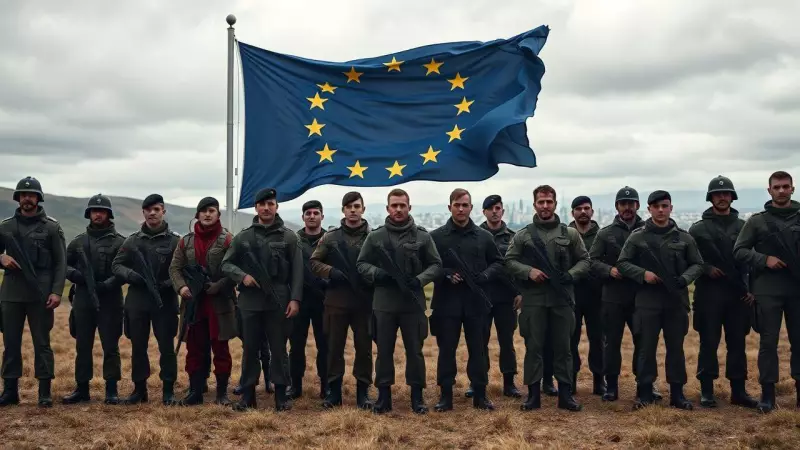
The European Union must seriously consider establishing a powerful, permanent joint military force of around 100,000 troops, a top EU defence official has stated. This force could one day replace the American military presence on the continent, addressing growing anxieties about Washington's long-term commitment to European security.
A Strategic Response to Shifting US Priorities
EU defence commissioner Andrius Kubilius presented this bold vision during a speech in Sweden. He framed the proposal as a direct answer to a critical strategic dilemma: "How will we replace the 100,000-strong American standing military force, which is the back-bone military force in Europe?"
His remarks arrive as multiple European nations reassess their security frameworks. Concerns have intensified following repeated statements by US President Donald Trump, including his interest in acquiring Greenland, which unsettled NATO partners. These events have fueled doubts about the reliability of the United States as a security guarantor.

Compounding this uncertainty is the US's long-standing push for Europe to take more responsibility for its own defence. Washington has also hinted at a potential strategic pivot, possibly moving troops away from Europe to focus more on challenges in the Indo-Pacific, particularly concerning China.
Overcoming Historical Hurdles for a United Defence
The concept of a centralised European army is not novel, having been debated for decades. However, it has consistently stalled due to national governments' reluctance to cede control over their sovereign armed forces.
Acknowledging the monumental challenge, Kubilius, a former Lithuanian prime minister, insisted Europe must confront tough questions. "In such times, we should not run away from the most pressing questions on our institutional defence readiness," he asserted.
Driven by both the wavering US support and the persistent threat from Russia, European governments have already begun increasing defence budgets and enhancing military preparedness. Kubilius's plan seeks to formalise and accelerate this shift towards strategic autonomy.
Blueprint for a New Security Architecture
Alongside the proposed standing force, Kubilius advocated for the creation of a "European Security Council" to enable quicker and more unified decision-making on defence issues. This body would comprise key European powers, potentially including Britain post-Brexit, with a mix of permanent and rotating seats totalling 10-12 members.
"The European Security Council could be composed of key permanent members, along with several rotational members," he explained. "In total around 10-12 members, with the task to discuss the most important issues in defence."
He emphasised that a top priority for this new council should be the war in Ukraine. Kubilius stressed that Europe requires a clear strategy to ensure Kyiv does not lose to Russia. "We need to have a clear answer – how is the EU going to change that scenario? This is the reason why we need to have a European Security Council now!" he declared.
The proposal marks a significant moment in the EU's journey toward greater defence integration, highlighting a continent preparing to stand more firmly on its own in an increasingly unpredictable geopolitical landscape.

