

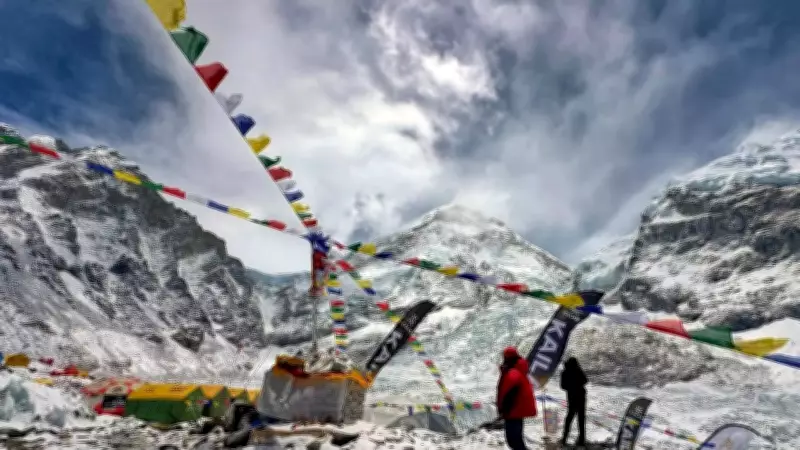
Another crowded Everest season has renewed debate over commercialization on the world's highest peak. The award-winning American writer Will Cockrell's 2024 book, 'Everest, Inc,' was the first full account of how the mountain transformed from an elite expedition into a billion-dollar industry. In an interview with Sharmila Ganesan Ram, he discusses why the summit still exerts an almost spiritual pull.
Has Everest Reached a Dangerous Tipping Point?
This season, Nepal issued nearly 500 Everest permits, China closed the Tibet route, concentrating traffic on a single face, and the mountain saw multiple deaths. Having closely studied the business of Everest, Cockrell believes the mountain has not reached a dangerous tipping point in terms of physical danger. He notes that deaths and injuries remain at an extraordinarily low rate relative to the number of climbers, and those numbers are either static or improving. With crowding, the primary issue is really one of aesthetics, and each climber has to decide whether that ruins the experience for them. There are still more challenging routes on the mountain that remain virtually empty.
Indian Climbers and Preparation
Two Indian climbers died during descent, reportedly due to altitude-related illness. Cockrell refrains from commenting specifically on these deaths due to lack of information. However, he points out a troubling scenario: climbers choosing to hire less support than they actually need at higher elevations, combined with a lack of understanding about what it takes to descend safely after summiting. The better guiding companies maintain a higher guide-to-client ratio for less-experienced climbers, but not all operators require this, leaving the decision to the climber.

Into Thin Air and Human Psychology
Jon Krakauer's famous book 'Into Thin Air' was written three decades ago, partly as a cautionary tale. Yet Cockrell argues that it actually accelerated Everest's popularity. He explains that humans are constantly searching for challenging and transformative experiences, and what qualifies as 'challenging' differs for each person. Many people came away from Krakauer's book believing that Everest was incredibly difficult and dangerous but still possible, which was a revelation for those dreaming of transformative challenges.
Overcrowding: Logistics, Regulation, or Ambition Culture?
This year, powerful jet stream winds narrowed the summit window to just a few days, sending hundreds of climbers onto the route almost simultaneously. Cockrell dismisses the idea that overcrowding is solely a logistics, regulation, or ambition culture issue. He notes that the decision about which summit window to use is ultimately made by guides. There is very rarely only one weather window, but clients are eager for the first window after spending so much time and money. Some inexperienced guides feel the same pressure. However, climbing during crowded summit pushes is not necessarily dangerous per se. Safety systems on Everest are now far more sophisticated, and good guides only take clients who can tolerate extra time at altitude. Weather forecasting has become remarkably accurate, and many climbers are willing to tolerate queues if it improves their chances of reaching the summit. Realistically, nobody comes to Everest seeking solitude.
Everest's Extraordinary Pull
There is a striking idea in Cockrell's book that Everest offers not just danger but reinvention. So many people are searching for reinvention, perspective, or some kind of awakening. Everest became that for many once guides started making the summit accessible to less experienced climbers. That was disappointing for some but an extraordinary gift for many. In America, extreme endurance challenges are sometimes jokingly described as 'suffer-fests'. There is something deeply human about feeling invigorated after prolonged physical hardship.
Is Everest Too Accessible?
Some argue that Everest has become 'too accessible' because of bottled oxygen, fixed ropes, luxury base camps, and premium guiding services. Cockrell counters that accessibility is not the problem; in many ways, it is the solution, meaning more safety systems and more safeguards.

What Would Hillary and Tenzing Think?
May 29 is celebrated as Everest Day, commemorating the historic 1953 ascent of Edmund Hillary and Tenzing Norgay. Cockrell believes that Hillary strongly disliked the commercial guiding industry even in its early stages. Many elite climbers feel resentment when something once considered extraordinarily difficult becomes achievable for ordinary people. He thinks Norgay would also be shocked, but that shock would be overshadowed by pride in what Sherpas have accomplished since his climb. The transformation of Sherpa society from expedition support workers to owners and leaders of the entire Everest economy was never inevitable. What Sherpas have built required extraordinary patience, intelligence, resilience, and vision, representing the recognition and respect that Tenzing always deserved.
Does Everest Still Change People?
Cockrell affirms that no matter how predictable the climb becomes, how luxurious base camp gets, how much oxygen you use, or how many guides support you, climbing Everest remains extremely hard for even the fittest people. Many people might still never make it to the summit regardless of the support available. So yes, he absolutely thinks reaching the top changes people.
