

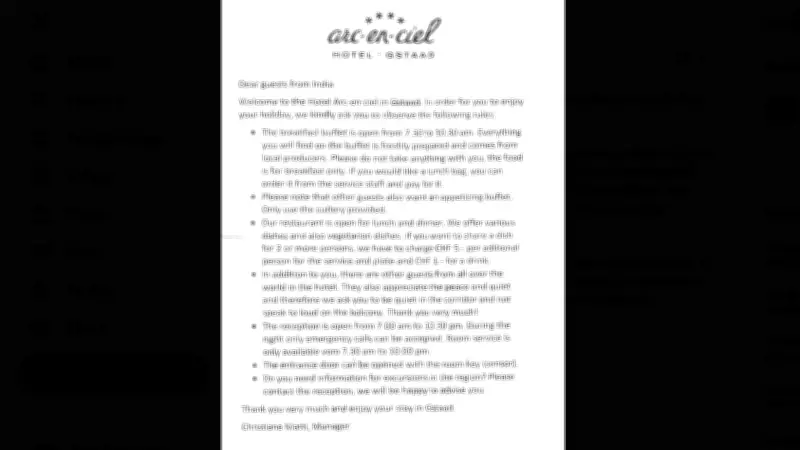
Industrialist Harsh Goenka recently shared a photograph of a notice he personally observed at a hotel in Gstaad, Switzerland. The notice, displayed at Hotel Arc-en-Ciel in the Swiss resort town, lists a set of rules specifically addressed to "Dear guests from India." This post has reignited an uncomfortable yet crucial debate about how Indian travelers are perceived overseas.
The Notice and Its Implications
The instructions in the notice are considered by many to be unusual and, to some extent, offensive. For instance, it states: "Please do not take anything with you, the food is for breakfast only. If you would like a lunch bag, you can order it from the service staff and pay for it." Another rule reads: "Please note that other guests also want an appetizing buffet. Only use the cutlery provided."
Goenka's Reaction
Goenka took to his X profile to share the image with a note expressing his dismay. He wrote: "A Swiss hotel once displayed a list of special rules exclusively for Indian guests which I personally saw and was appalled. Today, videos of garba in restaurants, loud conversations in airports, and turning aircraft cabins into picnic spots keep doing the rounds. Even in Davos, an Indian businessman blasted Punjabi music in a club so the whole town could hear it, calling it 'soft power' but to everyone's annoyance."

Singling Out Indian Guests
The hotel rule singled out Indian guests, reflecting a stereotype that no traveler wants associated with their nationality. The post resonated with many because it highlighted a reality: the behavior of a few travelers shapes perceptions of millions. This underscores the importance of being mindful of one's conduct when traveling abroad, as individuals represent their nation.
The Other Side: India as a Growing Travel Market
India is among the fastest-growing outbound travel markets. Industry reports indicate that tens of millions of Indians travel overseas annually, bringing significant economic benefits. Indian tourists are among the highest spenders in many international destinations, prompting airlines, hotels, and tourism boards to create products tailored specifically to Indians.
Cultural Disconnects
However, every positive aspect has its drawbacks. Hospitality professionals worldwide note that cultural expectations vary dramatically between countries. Large family groups dining together, speaking loudly in public spaces, carrying food from buffets, or treating hotel common areas as social zones are not appreciated everywhere. While such behavior may go unnoticed in many parts of India, it attracts attention abroad. The Swiss hotel notice exemplifies the cultural disconnect between countries.
Japan as a Benchmark
Goenka cited Japan as an example in his post. Visitors to Japan often praise the country's civic sense, noting orderly queues, clean public spaces, low noise levels, and a strong sense of empathy for others. This is not to suggest that Indians should imitate Japanese society, but rather to illustrate how travelers' behavior contributes to global perceptions of a country.
A Moment for Reflection
The notice at the Gstaad hotel attracts significant attention because it raises questions about whether the travel industry, schools, and families should do more to promote travel etiquette. It serves as a reminder that every traveler is an ambassador for their country the moment they step off an international plane. As Indians explore the world in record numbers, the debate is no longer about how much money they spend or where they travel, but about how they travel and how they represent their nation abroad.
This article is based on reporting by the TOI Lifestyle Desk, a team of dedicated journalists who curate lifestyle news for The Times of India readers.

