

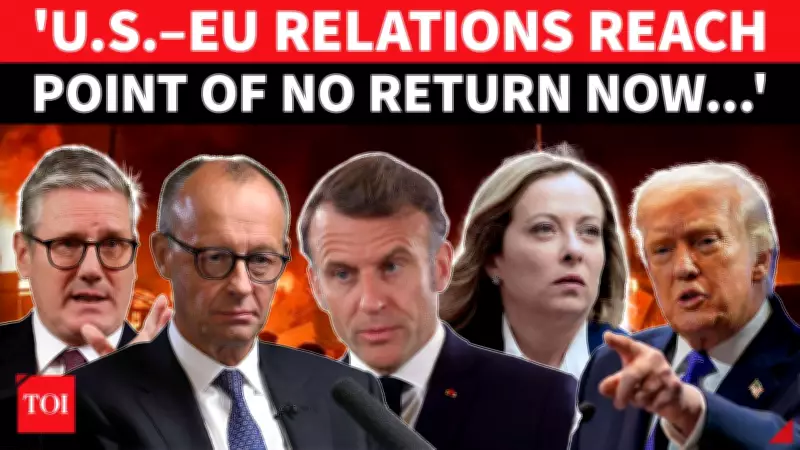
Serbian President Aleksandar Vučić has issued a stark warning about the deteriorating state of the Western alliance, declaring that the interests of Germany and the United States no longer coincide. In a chilling prediction, he asserted that the relationship has reached a historic split from which there is no return.
Watershed Moment for Global Security
Following President Trump's decision to withdraw U.S. troops from Germany, Vučić claimed that the world has reached a watershed moment that will fundamentally reshape global security dynamics. He described the move as a clear signal that the transatlantic partnership is unraveling.
Shift Toward Isolationism
Vučić pointed to Washington's shift toward an isolationist and transactional foreign policy, which he says has turned NATO into a "paper tiger." He warned that the Balkans are already preparing for a future where Moscow and Beijing step in to fill the vacuum left by the American retreat.

This development marks a significant departure from the post-World War II order, where the United States and Europe stood as unified pillars of democracy and security. The Serbian leader's comments underscore a growing sentiment among European nations that the alliance is no longer reliable.
Implications for the Balkans and Beyond
The Balkans, a region historically fraught with ethnic tensions and geopolitical rivalries, are particularly vulnerable to the shifting power dynamics. Vučić emphasized that smaller nations in the region must adapt to a new reality where the United States is no longer the guarantor of stability.
He predicted that Russia and China will seize the opportunity to expand their influence, offering economic and military partnerships that were previously unthinkable. This could lead to a realignment of alliances and a potential increase in regional conflicts.
Reactions from European Leaders
Vučić's warning has resonated across Europe, with many leaders expressing concern about the future of transatlantic relations. Some have called for a renewed commitment to NATO and European unity, while others acknowledge that the era of unquestioned U.S. leadership has passed.
Analysts suggest that the U.S. withdrawal from Germany is part of a broader trend of American disengagement from global affairs, a policy that has gained traction under the current administration. This has left European nations scrambling to bolster their own defense capabilities and seek new alliances.
Conclusion: A New World Order?
Vučić's prediction of a historic split between the U.S. and Europe may be alarmist, but it reflects a growing reality. As the United States pivots toward a more isolationist stance, the global order is being reshaped. Whether this leads to a multipolar world dominated by China, Russia, and regional powers remains to be seen, but the Balkans are already feeling the tremors.
The Serbian president's warning serves as a wake-up call for Europe: the transatlantic bond is no longer unbreakable, and nations must prepare for a future where they can no longer rely on American leadership.

