

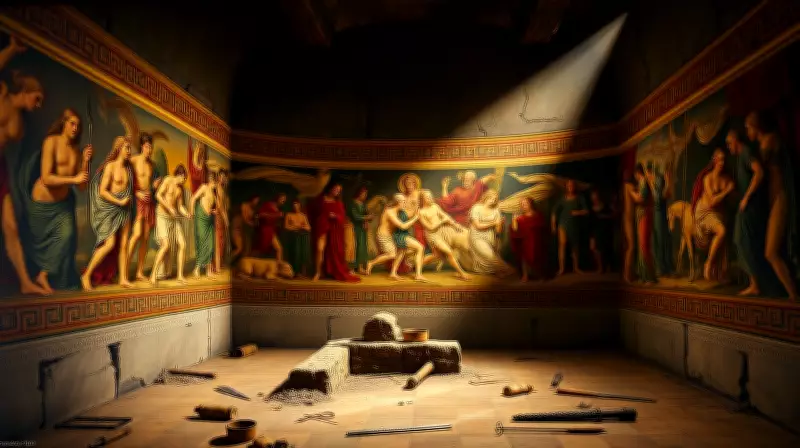
In 1921, Italy first wanted something it could not have. On this Monday in Rome, the Italian government finally got it. The François Tomb, one of the greatest surviving pieces of ancient painting on Earth, now belongs to the state. Italy paid $17.5 million for it. That might sound like a lot of money for an old painted wall, but consider this: the tomb was discovered back in 1857, over a century ago, and has been locked away ever since. It contains scenes that blend Greek mythology with Etruscan history, painted in colours that still glow after twenty-three centuries. These paintings tell stories nobody else painted about power, death, gods, and the moment when Etruscan civilisation was starting to fade into Roman history. This acquisition brings one of the world's most important monuments into public hands at last.
The François Tomb: A 2,300-year-old window into Etruscan life
The story begins on May 1, 1857. Archaeologist Alessandro François was exploring the Ponte Rotto necropolis near the ancient Etruscan city of Vulci in central Italy. The land belonged to Prince Alessandro Torlonia, and probably most people walking across it had no idea what lay beneath. But when François began digging, he found something extraordinary a tomb carved into the tufa rock with 37 painted panels still intact. The paintings had survived twenty-three centuries.
What François discovered was not just another funeral chamber. This was a masterpiece. The walls blazed with scenes that seemed to pull together everything the Etruscans knew about themselves and their world. There were Greek heroes and mythological monsters. There were scenes from Etruscan history and battles. There were demonic figures from Etruscan beliefs about the afterlife. All of it was painted with skill and confidence.

The tomb dates to somewhere between 340 and 320 B.C., right at the point where Etruscan power was declining, and Rome was starting to take over. That timing matters. The paintings feel like a statement of who the Etruscans were, painted at a moment when being Etruscan was becoming something you had to remember rather than something everyone just was.
The sacrifice scene that made the tomb famous: Reinterpreting Greek myth
One painting stands out above all the others. It shows the sacrifice of Trojan prisoners at the funeral of Patroclus, the famous warrior from Homer's Iliad. In the Greek version of the story, Achilles kills these prisoners in a rage of grief. The painter of the François Tomb knew that Greek story, but reinterpreted it through Etruscan eyes.
In the centre stands Achilles, just as the Greeks would expect. But surrounding him are Etruscan demons and underworld gods. There is Charun, a blue-skinned figure carrying a hammer, looking like an underworld guardian. Next to him appears Vanth, a winged figure associated with death and the afterlife in Etruscan religion. The scene is violent, with blood and brutality filling the composition. But the Etruscans added their own spiritual layer. They were not just telling a Greek story. They were saying: 'This is how we understand death, transformation, and the journey to the afterlife.'
This painting explains why the François Tomb matters so much. It shows that Etruscans were not just copying Greek culture. They were taking Greek ideas and making them their own, filtering them through their own beliefs and anxieties.
The Vulcian warriors and the link to early Rome: History painted on walls
Another famous scene shows a battle between Etruscans and rivals from the towns of Volsinii and Sovana, including three heroes of Vulci: Macstrna, who may have been Rome's legendary second Etruscan king Servius Tullius by another name, and two brothers, Caile and Avle Vipinas, who were probably actual historical figures. The names are written right there in Etruscan script, painted beside each figure.
This is extraordinary. Most ancient painting is mythological gods, heroes from legend, and timeless stories. But here, the Etruscans painted actual historical events or at least events they believed were historical. They painted their own warriors. They painted specific moments when their city fought against rivals. This was like painting a photograph of your town's military victory directly onto your tomb wall.

The research on identity-creation in the François Tomb shows how Etruscan families used the past to represent themselves. This tomb was not just a burial place. It was a statement. It said, 'We are warriors. We have history. We matter.'
The animal frieze and hunting scenes: Symbols of power and wealth
The upper walls show hunting scenes and a frieze populated by creatures both real and mythical griffins, lions, panthers, deer, boars, and fantastical beasts. This stretches across the longest known animal frieze from antiquity. For an Etruscan noble family, this meant something. Hunting was a mark of status. It showed you had the time and resources to pursue the game. Animals themselves could be symbols. Lions meant power. Eagles meant the heavens. Even the choice of which animals to paint told a story about who you were.
Between these scenes runs a geometric pattern, a 3D-perspective labyrinth meander that creates visual separation between the hunting scenes above and the main mythological scenes below. The attention to composition and detail shows real artistic training and confidence. This was not a quick job. Artists spent time planning and executing these walls.
Why this matters now: The Etruscan story we almost lost
For over a century and a half, the François Tomb sat on private land, largely closed to the public. Scholars could study photographs, but most people never saw it. The Italian government kept trying to acquire it but could not make a deal. That changed on June 2, 2026, when Culture Minister Alessandro Giuli signed the deed of sale.
The tomb will go on permanent display at the National Etruscan Museum at Villa Giulia in Rome starting June 25. An exhibition will bring together artefacts, documents, and loans from major museums across Europe, such as the Louvre, the British Museum, and the Vatican Museums. They are treating this like the masterpiece it is.
For the Etruscans themselves, that is fitting. They were a sophisticated civilisation that invented the toga, influenced Roman religion, and created some of the most beautiful art the ancient Mediterranean ever produced. Then Rome absorbed everything Etruscan, and over the centuries, people forgot who the Etruscans were. They became this mysterious ancient people that nobody quite understood.
The François Tomb is proof that they were anything but mysterious. They knew exactly who they were. They painted it on their tomb walls so the living would remember them. Twenty-three centuries later, we finally can.
