

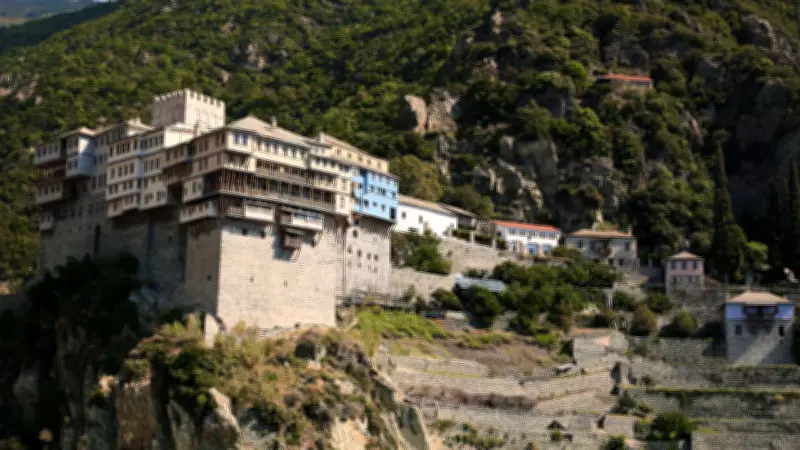
On a rugged peninsula in northern Greece lies one of Europe's most unusual and secluded places. Known as Mount Athos, or the Holy Mountain, this autonomous monastic community has barred women from entering for more than 1,000 years. Home to centuries-old Orthodox monasteries, ancient manuscripts, and a population made up almost entirely of monks, Mount Athos operates under a unique set of religious traditions that have survived wars, empires, and modern political change. Despite being part of Greece and the European Union, the sacred mountain continues to follow rules that date back to the Byzantine era.
Inside the Sacred Mount Athos Where Women Are Not Allowed
Mount Athos occupies the easternmost peninsula of the Halkidiki region in northern Greece. Although it is officially part of the Greek state, it enjoys a special autonomous status protected by the Greek Constitution. The territory covers about 335 square kilometres and contains 20 ruling monasteries, along with smaller hermitages, chapels, and monastic settlements. The administrative centre is Karyes, where representatives from the monasteries manage the affairs of the Holy Mountain.
Only a limited number of visitors are allowed to enter each day, and all must obtain a special permit before arriving. The prohibition on women, known as the Avaton, is one of Mount Athos' most famous and controversial traditions. The restriction dates back to Byzantine times and has been formally recognised for centuries.

According to Orthodox Christian tradition, the Virgin Mary visited the peninsula and claimed it as her own spiritual garden. Monks believe that excluding women helps preserve the celibate nature of monastic life and maintains the area's religious character. The ban applies to all women regardless of nationality, religion, or status. Most female domestic animals are also prohibited, with a few exceptions such as cats.
Home to Some of Christianity's Oldest Monasteries
Mount Athos is regarded as one of the most important spiritual centres of Eastern Orthodox Christianity. Several of its monasteries were founded more than 1,000 years ago and continue to function today. The monasteries house priceless collections of Byzantine icons, religious relics, ancient manuscripts, and historic artworks. Many buildings feature distinctive architecture that has remained largely unchanged for centuries. Because of its cultural and religious significance, Mount Athos was designated a UNESCO World Heritage Site in 1988.
A World Where Ancient Traditions Still Shape Daily Life
Life on Mount Athos follows a rhythm very different from that of modern cities. Monks devote much of their day to prayer, worship, manual labour, and study. Many monasteries maintain traditional schedules that begin before dawn and include long religious services. Visitors often describe the atmosphere as peaceful and timeless, with stone pathways linking monasteries perched above the Aegean Sea. Technology and outside influences are generally kept to a minimum, helping preserve the mountain's centuries-old monastic culture.
The Debate Over the Women-Only Exclusion
The ban on women has attracted criticism from some human rights and equality groups over the years. The European Parliament has previously questioned whether the restriction is compatible with modern principles of gender equality. However, Mount Athos retains a special legal status that has been recognised by Greece and acknowledged within the framework of the European Union. Supporters argue that the restriction is part of the peninsula's unique religious identity and should be protected as a matter of religious freedom. The debate continues, but the rule remains firmly in place.
Why Mount Athos Remains One of Europe's Most Mysterious Places
Few places in Europe combine such deep history, religious significance, and isolation. Behind its restricted borders lies a community that has preserved traditions largely unchanged since the Middle Ages. For believers, Mount Athos is one of the holiest places in the Orthodox Christian world. For visitors, it offers a rare glimpse into a way of life that has endured for more than a thousand years. Whether viewed as a spiritual sanctuary, a historical treasure, or a cultural curiosity, Mount Athos remains one of the continent's most extraordinary destinations.

