

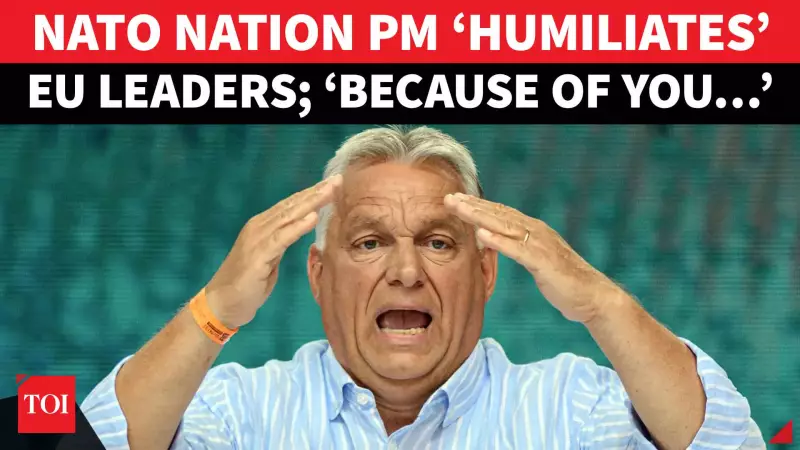
In a dramatic and highly critical public statement, Hungarian Prime Minister Viktor Orban has launched a fierce verbal assault on fellow European Union leaders. He accused them of fundamentally derailing the bloc's purpose by prioritizing military confrontation with Russia over the pursuit of peace and stability.
Orban's Scathing Critique of EU Leadership
Speaking out on December 31, 2025, Orban did not mince words. He asserted that meetings of the European Council, which should focus on development and cooperation, have effectively been transformed into 'war councils'. According to the Hungarian leader, these gatherings are now singularly obsessed with planning for the defeat of Russia, a shift he views as a dangerous abandonment of the EU's foundational principles.
'Debates on development and stability have vanished,' Orban claimed, highlighting his central grievance. He stated that these crucial discussions have been replaced by what he described as relentless and narrow-minded strategizing for continued conflict.

A 'Historic Rupture' in Transatlantic Stance
Orban framed the past year as a period of significant divergence, not just within Europe, but across the Atlantic. He presented a striking contrast in geopolitical objectives. According to his analysis, Washington is currently seeking a path to end the conflict in Ukraine. In a bold claim, he countered that the European Union's leadership is moving in the opposite direction, allegedly determined to prolong the war.
This portrayal paints a picture of a historic rupture where Europe's stance has hardened beyond even that of the United States, a traditional security guarantor. Orban's comments directly challenge the unified front often presented by NATO and EU institutions regarding the ongoing war.
Implications and the Road Ahead
The public shaming of EU allies by the Prime Minister of a member state is a significant event that exposes deep fissures within the bloc. Orban's government has long been at odds with the mainstream EU position on Russia, often advocating for a more conciliatory approach and criticizing sanctions.
This latest outburst is likely to further strain Hungary's relations with key powers like Germany and France. It raises serious questions about the EU's ability to maintain a cohesive foreign policy. Furthermore, it provides rhetorical ammunition for those outside the bloc who argue that the West is not genuinely interested in a negotiated peace.
The incident underscores the ongoing tension within Europe between the drive to support Ukraine and the search for a diplomatic off-ramp. As the conflict continues, such public disagreements among allies could complicate strategic decision-making and present a fragmented face to the world.

