

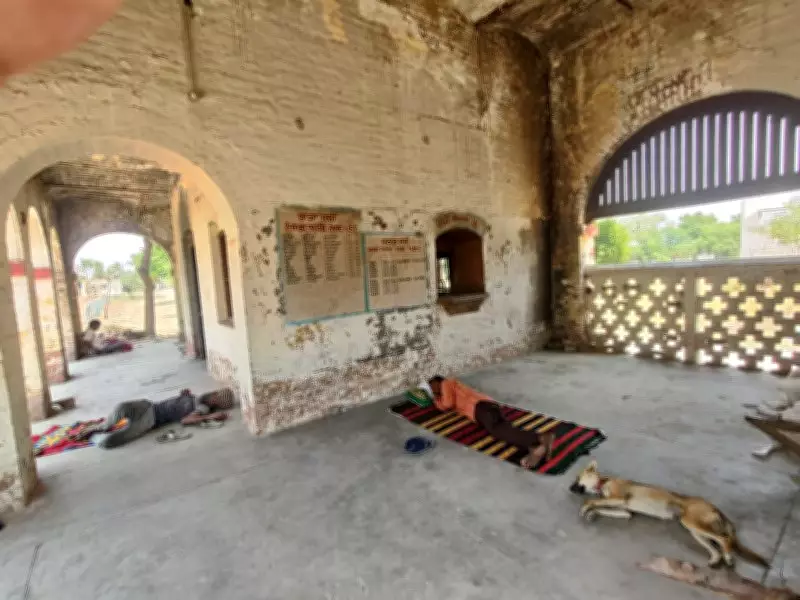
Hidden among fields on the outskirts of Gurwali village, a short distance from the historic Gurdwara Sangrana Sahib, stands a railway station that once connected villagers, pilgrims, and traders to the wider region. Today, however, the Sangrana Sahib railway station is a silent reminder of a past era. Declared abandoned by the Railways nearly a decade ago, the station no longer witnesses the bustle of passengers, the sound of the bell, ticket sales, or the arrival of trains. Yet, more than a century after it was built, its sturdy brick structure continues to stand as a monument to Punjab’s railway heritage.
A Glimpse into the Past
A visitor arriving at the station today is greeted by an intriguing sight: The ticket window remains open, as if waiting for passengers who never arrive, but there is no ticket clerk behind it. A faded fare chart from 2015 still hangs on the wall, listing the fare to Patti at just Rs 10. The railway tracks remain active, and trains continue to run on the Amritsar-Khem Karan route, but none stop at the Sangrana Sahib station anymore. The deserted station has found a different role in recent years: A few unhoused individuals have made the abandoned building their permanent shelter. Their daily meals are often arranged through the nearby Gurdwara Sangrana Sahib.
Historical Significance
The story of the station begins more than 100 years ago. When the broad-gauge railway line connecting Amritsar, Tarn Taran, Khem Karan, and Kasur was inaugurated on September 21, 1906, a station was established outside Gurwali village. Since it was located near the historic Gurdwara Sangrana Sahib, the station was named after the shrine. For decades, the Sangrana Sahib station served as an important stop on the route. Trains departing from Amritsar Junction towards Khem Karan would halt at Bhagtanwala before reaching Sangrana Sahib, where passengers boarded and disembarked. The station was particularly useful for devotees visiting the historic gurdwaras of the region, traders travelling to the Bhagtanwala grain market, and villagers commuting to Amritsar and Tarn Taran.

Older residents recall a time when the station bustled with activity. Pilgrims carrying offerings, traders transporting goods, and villagers heading to the city would gather on the platform waiting for the train’s arrival. The station served as a lifeline for surrounding villages long before road transport became widespread.
Railway Line Construction
The railway line itself represents an important chapter in the transportation history of Punjab. Constructed by Killick, Nixon and Company under North Western State Railway Company, the line was built in phases. The first section — from Amritsar Junction to Tarn Taran, measuring 23.4 km — opened on September 21, 1906. The Tarn Taran-Patti section followed on December 30, 1906, while the Patti-Kasur section was commissioned on April 4, 1910. The final link connecting Khem Karan and Kasur opened on January 3, 1911.
Impact of Partition
Before the 1947 Partition, the railway route linked Amritsar directly with Kasur, now in Pakistan. The division of Punjab severed this historic connection, and the 34-km Khem Karan-Kasur section was dismantled. Thereafter, trains operated only up to Khem Karan, transforming what had once been an international rail corridor into a border-end route.
Decline and Current State
The decline of the Sangrana Sahib railway station came gradually. As road connectivity improved and passenger patterns changed, authorities reduced operations at smaller stations. Eventually, the Sangrana Sahib station was declared abandoned, ending more than a century of service to the local community. Despite its closure, the station remains an important piece of local history. Its weathered walls, empty ticket window, and silent platform continue to tell the story of a period when the railway transformed travel and commerce across rural Punjab. Today, as trains continue to pass by without stopping, the abandoned station remains frozen in time. For heritage enthusiasts and area residents alike, the Sangrana Sahib railway station is more than a disused building — it is a surviving relic of Punjab’s railway past, quietly waiting for its story to be remembered once again. Locals demand that the heritage building be preserved.

