

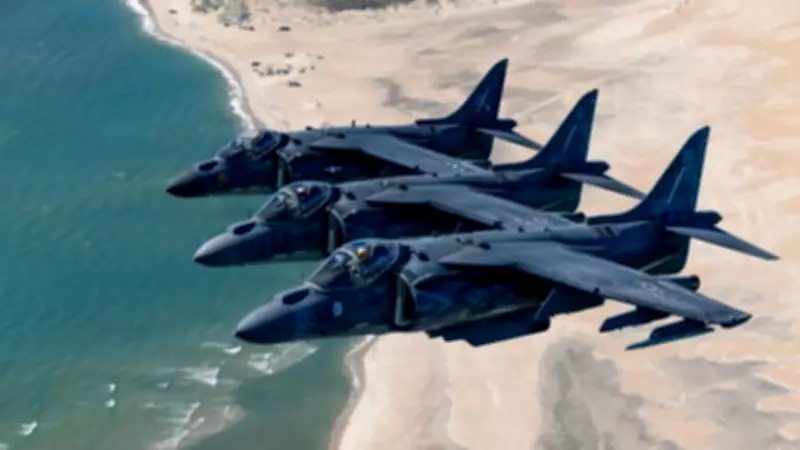
Almost ten years after the Indian Navy retired its last British-made Sea Harrier, the United States Marine Corps (USMC) is set to retire the AV-8B Sea Harrier Jump Jet. What made the Harrier family of aircraft unique was their design to operate in high-intensity conflicts, should the Cold War have turned hot.
Origin and Purpose of the Harrier
It was assumed that if hostilities broke out, airfields from which fighters and bombers operated would be among the first targets to be hit. The specter of losing critical infrastructure, such as runways on airbases, would render otherwise fully functional fighter fleets useless. The most basic solution was to have fighters fly from dispersed and ad hoc airfields or highways, but without the facilities available at these airbases, such operations could not be sustained for extended periods. The Indian Air Force continuously practices taking off and landing from various expressways across the country.
Another solution was to have runway-independent aircraft, such as the Harrier family of jets. These aircraft could theoretically take off from any open field, without worrying about the state of the runway upon return. Another advantage, which the US Marine Corps particularly valued, was the ability to operate the aircraft from virtually anywhere due to their Vertical Take-Off and Landing (VTOL) and Short Take-off and Vertical Landing (STOVL) capabilities. For the Marines, this meant deploying aircraft close to frontlines, reducing time for close air support. The aircraft could land, rearm, and return faster than other aircraft dependent on airbases located much farther away. The Soviets also operated similar aircraft, the Yakovlev Yak-38, and developed the Yak-141.

Expert Commentary
“End of an era. The Harrier was a technological marvel. It provided a solution for restricted area operations, from smaller aircraft carriers and land hideouts. Its vectoring in forward flight gave an edge in air combat against more superior air superiority fighters. For the Marine Corps, it was a boon since it supported US Marine induction in far-off shores. It is for this reason that the technology has been largely retained in the F-35B with VTOL/STOVL ability. Long live VSTOL,” said Vice Admiral Shekhar Sinha, former Western Fleet commander and a naval fighter pilot who flew the Sea Harrier.
Operational Advantages and Retirement
Another advantage of these aircraft was their ability to operate from smaller aircraft carriers. This removed the need for complex steam-powered catapults and arresting gear required to reduce aircraft speed safely. This is why the Indian Navy and the UK’s Royal Navy operated the aircraft in large numbers. The Indian Navy started operating the MiG-29K from INS Vikramaditya and later the indigenous INS Vikrant. Similarly, both the Royal Navy and the USMC have moved on to the F-35B, the VTOL/STOVL version of the fifth-generation fighter.
The retirement of the AV-8B Harrier marks the end of a significant chapter in military aviation. The aircraft served for decades, providing unique capabilities that influenced the design of modern fighters like the F-35B. The legacy of the Harrier lives on in the continued use of VTOL technology in contemporary military aviation.

