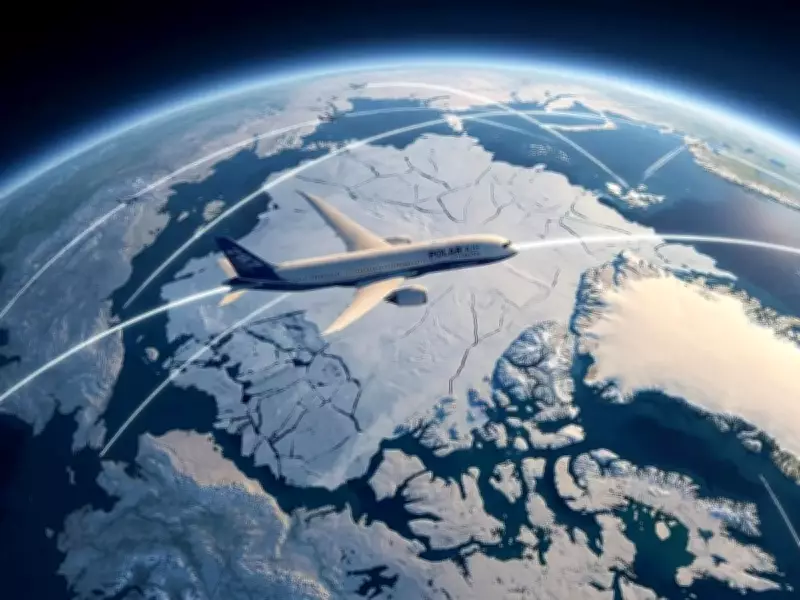
Have you ever tracked a long-haul flight and noticed an intriguing pattern? Aircraft routes often deviate far north, approaching the Arctic region. However, planes practically never fly south near Antarctica. This is not random; it is driven by geography, economics, environmental factors, and regulatory constraints.
Shape of the Earth Determines Flight Routes
Planes do not fly in straight lines as shown on flat maps. Instead, they follow great circle routes, which represent the shortest distance between two points on a sphere. Because most major cities are in the Northern Hemisphere, routes connecting them are often shorter when passing over the poles. For instance, flights from New York to Hong Kong or London to Tokyo typically cross Greenland or North America. Shortening routes saves airlines significant fuel costs; even a few hundred kilometers can result in huge savings. Polar routes can cut thousands of miles off flight distances.
In the Southern Hemisphere, the situation is different. Cities like Sydney, Johannesburg, and Santiago are positioned such that flights do not need to traverse Antarctica. Instead, they generally follow open water paths.

Demand Drives Flight Paths
Another critical factor is travel demand. The busiest flight routes connect North America, Europe, and Asia, which account for the largest numbers of passengers and cargo shipments. Airlines such as United Airlines, Lufthansa, and Air Canada regularly operate transpolar flights to link these economic hubs. Antarctica, by contrast, has no cities, no commercial airports, and minimal demand for passenger flights. Without economic incentives, airlines are unwilling to risk operating over a remote region far from civilization.
Safety Regulations Govern Routes
Aviation is heavily regulated under ETOPS (Extended-range Twin-engine Operational Performance Standards) guidelines. These rules require aircraft to stay within a certain flight time of a suitable diversion airport in case of emergencies. For most long-haul flights, this ranges from 180 to over 300 minutes. The Arctic has several designated diversion airports, including Anchorage in Alaska, Keflavik in Iceland, and Iqaluit in Canada. Antarctica, however, lacks such infrastructure. Only a few research airstrips exist, which cannot be used commercially under typical weather conditions. From a safety perspective, Antarctica is one of the riskiest zones for airliners, with no emergency landing options.
Extreme Weather Increases Hazard
Both polar regions experience freezing temperatures, but Antarctica is far more severe. It is the coldest and windiest continent, with temperatures dropping below minus 60 degrees Celsius. Weather predictions are challenging due to a lack of monitoring stations, complicating route planning. The Arctic, by contrast, benefits from land-based infrastructure and reliable weather reports. Additionally, Antarctica experiences extended darkness during winter, which could hinder emergency procedures.
Historical Context Shaped Current Routes
The current aviation network evolved from historical developments. During the Cold War, military experts invested heavily in Arctic navigation because the shortest route between the United States and the Soviet Union crossed the polar region. Commercial airlines later leveraged these advances, beginning transpolar flights in the 1990s with aircraft like the Boeing 747. Antarctica saw no similar military or economic impetus, so commercial routes never developed there.
Flights Approach but Do Not Cross Antarctica
Some flights in the Southern Hemisphere, such as those from Chile to Australia or New Zealand, may pass near Antarctica but do not cross the continent. Specialized flights to Antarctica exist for scientific or recreational purposes, but they are rare. A notable example is Air New Zealand Flight 901, which crashed in 1979 during a sightseeing expedition, highlighting the region's dangers.
Conclusion
Air travel over the Arctic thrives due to efficiency, infrastructure, and demand—factors that are absent in Antarctica. Regulatory, geographical, and weather-related reasons collectively explain why commercial airlines avoid crossing the southern continent. Even today, Antarctica remains one of the few regions where airlines do not venture.