

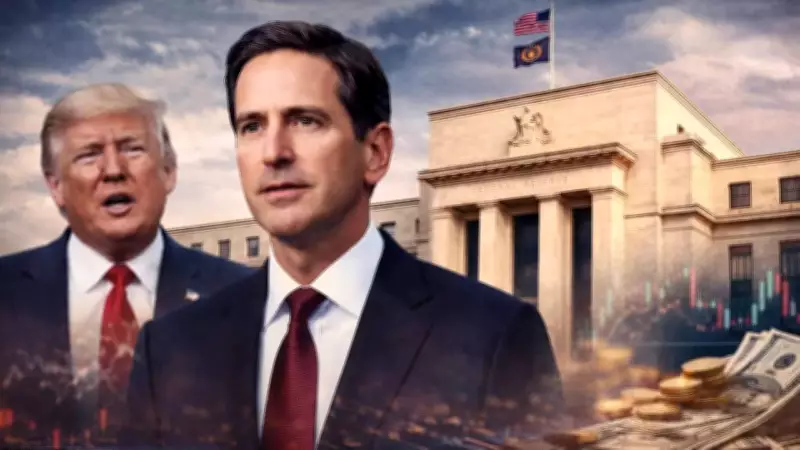
Kevin Warsh Emerges as Leading Candidate for Federal Reserve Chair Position
As the United States approaches what could be a transformative moment in global economic policy, former Federal Reserve Governor Kevin Warsh has emerged as the primary contender to succeed Jerome Powell as the next Federal Reserve Chair. This crucial decision is anticipated to be formally announced by President Donald Trump in the coming days, creating significant ripples across financial markets worldwide.
White House Discussions Propel Warsh's Candidacy Forward
According to sources familiar with internal White House deliberations, Warsh's candidacy gained substantial momentum following a private meeting with President Trump at the White House on January 29-30, 2026. During this confidential discussion, Warsh reportedly impressed senior administration officials with his comprehensive views on monetary policy and broader economic strategy. While the formal nomination announcement had not been made as of Thursday evening, President Trump has indicated that his selection would be revealed the following day, describing his choice as someone "respected and well-known in the financial world"—a characterization that many observers believe aligns perfectly with Warsh's profile.
Who Is Kevin Warsh: The Contender at the Heart of Federal Reserve Drama
Kevin Warsh brings substantial experience to the table, having previously served on the Federal Reserve Board of Governors from 2006 to 2011 under both Presidents George W. Bush and Barack Obama. During his tenure, he played a pivotal role during the 2008 financial crisis, acting as the central bank's primary liaison to Wall Street institutions. Following his departure from the Federal Reserve, Warsh transitioned into academia and economic research, holding distinguished positions including a visiting fellowship at Stanford University's Hoover Institution while advising both public and private organizations on complex economic and monetary matters.

Beyond his impressive academic credentials, Warsh has established himself as a prominent voice in central banking policy debates. He has consistently advocated for what he terms a "regime change" in how the Federal Reserve approaches monetary strategy, expressing skepticism about long-term reliance on expansive balance sheets and traditional inflation targeting frameworks. In his numerous commentaries and writings, Warsh has emphasized the transformative potential of productivity-enhancing technologies like artificial intelligence to reshape economic growth patterns—a perspective that resonates strongly with business leaders concerned about future global competitiveness.
From Private Meeting to Front-Runner: The Turning Point for Warsh's Candidacy
The decisive moment in Warsh's candidacy appears to have been his recent confidential White House meeting, which sources described as both "impressive" and highly productive. During this encounter, Warsh articulated his comprehensive vision for the central bank and its relationship with broader US economic policy objectives. This discussion reportedly elevated his standing in President Trump's assessment at a time when the president has been openly critical of current Fed Chair Jerome Powell for what he perceives as insufficient interest rate reductions.
President Trump has repeatedly called for significant changes to Federal Reserve policy, including substantially lower interest rates, and has publicly rebuked Powell for what he views as inadequate monetary easing measures. Warsh's nuanced approach—which advocates for both strategic interest rate considerations and structural reforms—may appeal to Trump's desire for a Federal Reserve chair who aligns more closely with political priorities while maintaining substantial institutional credibility.

Market Reactions and Global Implications of Warsh's Rising Prospects
The increasing likelihood of Warsh's nomination has already triggered noticeable market movements. Prediction markets have shown Warsh's probability of nomination skyrocketing, while investors across various asset classes are repositioning their portfolios in anticipation of potential shifts in US monetary policy direction. Global stock and bond markets have reacted to the speculation, with the US dollar strengthening and yields climbing in expectation of a Federal Reserve chair potentially less inclined toward aggressive rate-cutting measures.
In the cryptocurrency sector, assets including Bitcoin have experienced significant volatility as traders recalibrate their expectations regarding liquidity conditions under a prospective Warsh-led Federal Reserve. Economists and market participants are monitoring these developments closely because the Federal Reserve Chair wields enormous influence not only over US interest rates and inflation expectations but also over global capital flows, exchange rate dynamics, and risk asset pricing mechanisms.
Questions About Federal Reserve Independence and Future Direction
The nomination process has reignited important questions about the independence of the Federal Reserve, traditionally regarded as an apolitical institution designed to make decisions based primarily on economic data rather than political considerations. President Trump's comments about wanting a Federal Reserve chair who consults with him on interest rate decisions represent a departure from recent norms and highlight ongoing tensions between executive branch priorities and central banking autonomy.
As Kevin Warsh stands poised to potentially assume leadership of the world's most influential central bank, his candidacy reflects a broader debate about how monetary policy should balance competing objectives of economic growth, inflation control, and financial stability in an increasingly complex global economy. His emphasis on structural reform and balanced policy approaches contrasts with Jerome Powell's more cautious, data-centric methodology, suggesting that a Warsh appointment could redefine how the Federal Reserve engages with both domestic and international economic challenges.
The ultimate selection of the next Federal Reserve Chair—whether Warsh or another candidate—will reverberate far beyond US borders, shaping global financial conditions, influencing emerging market currencies, and affecting investment strategies from Asia to Europe. With the official announcement expected imminently, investors, policymakers, and everyday consumers worldwide are preparing for a potential new chapter in central banking leadership and what could be a consequential pivot in monetary policy direction.





