China is undertaking a major global marketing campaign for its tropical island province of Hainan, promoting it as a premier duty-free shopping destination. This push comes against the backdrop of a colossal and growing trade surplus, which has sparked criticism from trading partners worldwide.
The $1 Trillion Surplus and Global Trade Tensions
Official data reveals that China's cumulative trade surplus with the rest of the world has surpassed a staggering $1 trillion over the past two years. In 2023 alone, the surplus stood at $823 billion. This immense imbalance has become a central point of contention in international economic relations, with major economies like the United States and the European Union urging Beijing to boost its domestic consumption and increase imports.
Critics argue that China's export-oriented model, supported by state subsidies and industrial policies, floods global markets while its own market remains relatively difficult to access for foreign goods. The European Chamber of Commerce in China has explicitly stated that the country's "production capacity significantly exceeds domestic demand."

Hainan: The Duty-Free Showcase for "Opening Up"
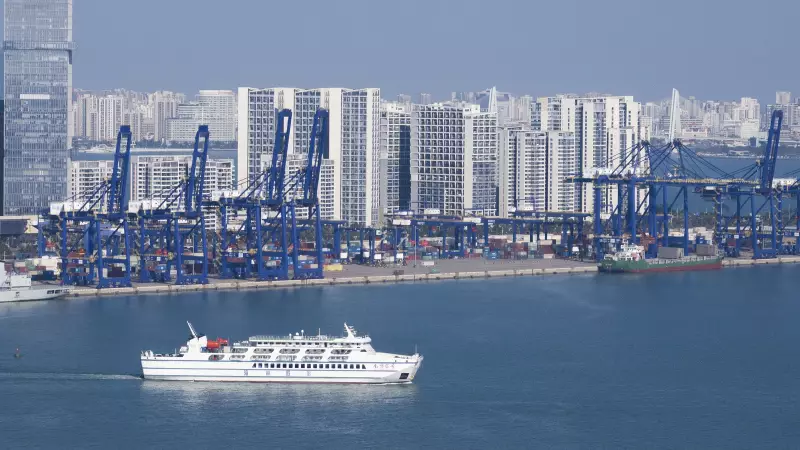
In this context, Hainan Island is being positioned as a glittering symbol of China's commitment to open its markets. The central government has designated the entire island as a free trade port, with a goal of achieving full implementation of this policy by 2025. A key attraction is the duty-free shopping allowance, which has been increased to 100,000 yuan (approximately $13,800) per person annually, a significant jump from previous limits.
Authorities are pulling out all stops to promote Hainan on the world stage. The recent Boao Forum for Asia, held on the island, served as a key platform. International celebrities, including Hollywood actor Christian Bale, were featured in promotional videos. The provincial governor, Liu Xiaoming, actively pitched the island's advantages to global business leaders attending the forum, highlighting the duty-free policy and streamlined customs clearance.
Strategic Goals and Underlying Challenges
The campaign for Hainan serves multiple strategic purposes for China. Primarily, it aims to boost imports of high-end consumer goods and luxury items, thereby addressing some criticisms about trade imbalances. It also seeks to project an image of a confident, open economy that is attractive to tourists and investors alike. Furthermore, it is part of a broader plan to develop Hainan into a key economic hub for the Asia-Pacific region.
However, analysts point out significant challenges. While duty-free shopping is popular, transforming Hainan into a truly global destination requires more than just shopping malls. Issues such as international flight connectivity, language barriers, and service standards need to be addressed. Moreover, the scale of spending in Hainan, though impressive, is still a drop in the ocean compared to China's monumental trade surplus. The initiative is seen as a positive step but not a comprehensive solution to deep-rooted global trade tensions.
Global Reception and Future Implications
The world is watching China's Hainan experiment closely. Trading partners may view it as a test of Beijing's willingness to rebalance its economic relationships. The success or failure of the duty-free port could influence future trade negotiations and diplomatic dialogues concerning market access.
Ultimately, the story of Hainan's duty-free push is inextricably linked to China's broader economic narrative. As the country grapples with a property crisis and seeks new growth engines, boosting domestic consumption is critical. Hainan is a flashy flagship project in this endeavour. Yet, whether this island paradise can help smooth the rough waters of a $1 trillion trade surplus remains one of the most pressing questions in the global economy today.