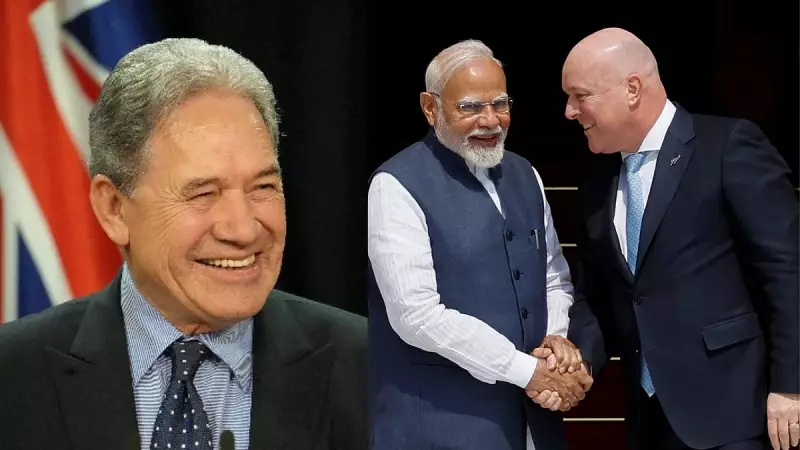
New Zealand's Foreign Minister, Winston Peters, has taken a firm stance against pursuing a free trade agreement (FTA) with India, citing significant concerns over the state of democracy in the South Asian nation. His comments, made during a parliamentary debate, directly reference India's recent general elections, which he described as "neither free nor fair." This public criticism introduces a new layer of diplomatic friction between the two countries, potentially complicating long-standing efforts to deepen economic ties.
Diplomatic Tensions Over Democratic Values
The controversy erupted during a session in New Zealand's parliament focused on the government's foreign policy strategy. Minister Peters, who also serves as the Deputy Prime Minister, was defending his ministry's performance when he made the pointed remarks about India. He explicitly linked his opposition to a potential trade deal with his assessment of India's electoral integrity. This public articulation of such a sensitive critique marks a notable shift in diplomatic tone from Wellington.
Peters' comments are a direct reference to India's massive recent Lok Sabha elections, a multi-phase democratic exercise involving hundreds of millions of voters. While international observers have noted the scale and logistical complexity of the Indian polls, Peters' characterization is among the most blunt criticisms from a senior foreign official of a friendly nation. The Indian government, led by Prime Minister Narendra Modi, has consistently defended the elections as robust and democratic.

Economic Implications for Bilateral Trade
This political stance has immediate consequences for economic relations. New Zealand and India have been engaged in on-and-off negotiations for a free trade agreement for over a decade. An FTA is designed to reduce or eliminate tariffs and other trade barriers, boosting the flow of goods and services between the two countries. For New Zealand, key export interests in the Indian market include dairy products, meat, wool, and fruits. India, conversely, sees opportunities in information technology, pharmaceuticals, and services.
Peters' declaration suggests that under the current New Zealand coalition government, which includes his New Zealand First party, progress on this trade front is unlikely. He framed the decision as a matter of principle, stating that New Zealand should not enter into such significant agreements with countries where democratic norms are perceived to be under threat. This position effectively puts the ambitious trade talks on indefinite hold, to the disappointment of business sectors in both nations that have long advocated for a pact.
Broader Context and Potential Fallout
The New Zealand Foreign Minister's criticism does not exist in a vacuum. It aligns with a growing chorus of concern from various Western democracies and human rights organizations regarding political freedom and minority rights in India. However, such concerns are rarely stated so explicitly as a barrier to formal economic engagement. The Indian government is likely to view these comments as unwarranted interference in its internal affairs.
This incident tests the resilience of the broader India-New Zealand relationship, which has generally been cordial and cooperative in forums like the Commonwealth and the United Nations. The two countries also share ties through cricket and a significant Indian diaspora community in New Zealand. How India officially responds to Peters' remarks will be closely watched. Options range from diplomatic demarches to a more muted, behind-the-scenes approach aimed at managing the fallout without escalating tensions further.
The core issue, as framed by Winston Peters, is a direct clash between economic interest and diplomatic principle. By prioritizing a values-based foreign policy, New Zealand's current leadership is signaling a willingness to forgo potential trade gains. This move sets a precedent and raises questions about how other democracies might navigate relations with India, a crucial global economic player and strategic partner, amid similar concerns. The stalemate over the free trade agreement looks set to continue, with its resolution now deeply entangled with perceptions of democratic health in India.