

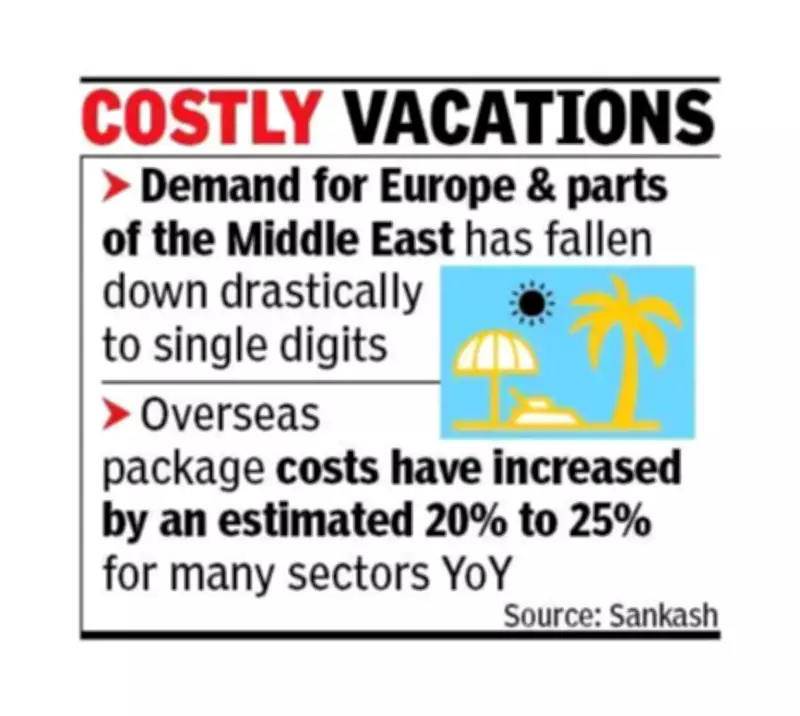
Chennai: Summer vacations for Indians to exotic destinations have been thrown out of gear as the West Asia conflict and a weakening rupee have made overseas tour packages expensive by about 20%. This has washed away the benefits of a substantial cut in Tax Collected at Source (TCS) announced by the Centre on overseas tour programme packages this year—from 20% and 5% to a mere 2%.
Moreover, the ongoing conflict has resulted in a significant drop in the number of international trips between April and June, the period when a large number of Indian families travel due to school summer holidays.
Rajiv Mehra, general secretary, Federation of Associations in Indian Tourism & Hospitality (FAITH), said outbound travel has been badly hit. "We are seeing a significant drop in demand. One can easily say that there is an overall decline of 15%–20% as of now compared to last year (April–June 15, 2026 vs April–June 15, 2025). About 35% of Indians were travelling to the UAE and Gulf region, and that travel is now almost negligible. Travel to Europe has also dropped significantly. The key reason is the war, which has led to a rise in oil prices and insurance costs, resulting in high airfares. Further, currency depreciation, visa delays, and a general perception that travel is not safe have contributed to the decline in overseas travel," he said.

Sriharan Balan, MD of Chennai-headquartered Madura Travel Service, said the US dollar strengthened against the rupee by almost Rs 10 over the past year—from Rs 84 to Rs 94 (April 2025 vs April 2026)—making international travel more expensive. "Last-minute bookings have gone up," he observed.
Travel fintech SanKash said overseas package costs have increased by an estimated 20%–25% year-on-year across many sectors. "This increase is more recent; it's not that the whole year was bad. Till Jan, most routes were maybe 5%–10% higher, which was manageable. The real jump came after the West Asia situation worsened," its co-founder and CEO, Akash Dahiya, said.
Destination choices have also shifted sharply. S D Nandakumar, president & country head – Holidays & Corporate Tours, SOTC Travel, said the ongoing West Asia situation has influenced traveller preferences. "Eastbound and Far East destinations such as Japan, South Korea, Thailand, Vietnam, the Philippines, China, and Australia–New Zealand continue to remain preferred choices. At the same time, closer-to-home international destinations like Nepal and Sri Lanka, along with domestic travel across Kashmir, Ladakh, Himachal, Kerala, the Andamans, and the Northeast, continue to see steady traction," he said.






