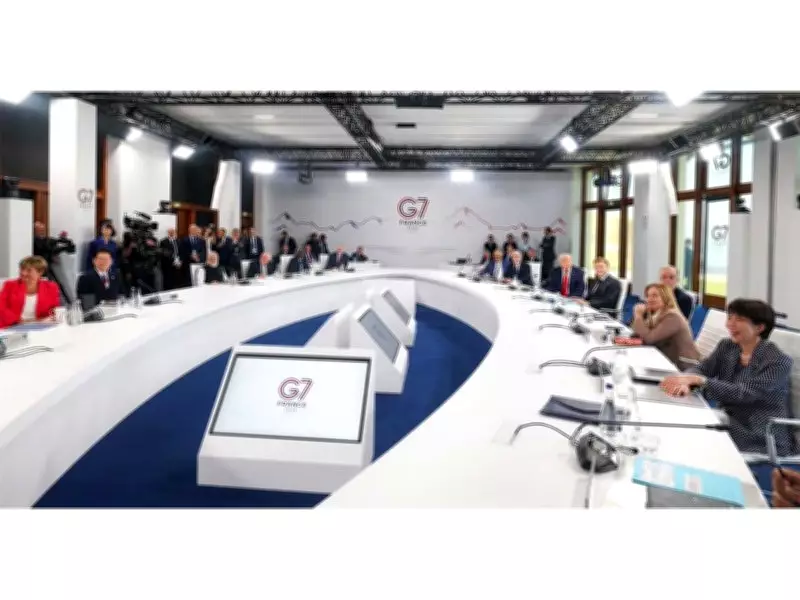
The Group of Seven (G7) leaders unveiled a joint declaration on Wednesday to strengthen the resilience of critical minerals supply chains, expressing concern over non-market policies and practices and the use of economic coercion in global trade.
Commitment to Reduce Vulnerabilities
In a joint declaration on securing supply chains for critical minerals, the G7 leaders stated their commitment to reducing vulnerabilities stemming from concentrated supply chains and arbitrary trade restrictions.
"We express our grave concerns regarding the use of non-market policies and practices and economic coercion, including arbitrary export restrictions and retaliatory measures on critical minerals and their related dual-use items, all of which undermine economic security and resilience," the declaration read. "We will work together with partners to reduce critical dependencies and ensure that attempts or threats to weaponize economic dependencies fail."

Diversification and Domestic Capabilities
The leaders reaffirmed their commitment to diversifying supply chains and strengthening domestic and allied production, processing, and recycling capabilities for minerals critical to digital technologies, clean energy, and industrial manufacturing.
Building on the Critical Minerals Production Alliance established under Canada's 2025 G7 presidency, the countries pledged to coordinate investments and industrial projects across the entire value chain. They set a goal of reducing dependence on any single supplier outside the G7 and partner countries for rare earths and permanent magnets to below 60 percent by 2030, with an ambition to reach 50 percent as soon as possible.
"We, together with partner countries, will cooperate closely to advance production, processing and recycling projects across the entire supply chain," the leaders said, noting that 195 projects announced since the beginning of 2026 have already attracted EUR 64 billion in investment.
Financing and Market Stability
The declaration also highlighted the need for greater public and private financing, calling on multilateral development banks, development finance institutions, and export credit agencies to coordinate support for critical minerals projects and related infrastructure.
Recognizing the importance of market stability, the G7 said it would continue exploring measures including diversification requirements, joint procurement tools, revenue stabilization mechanisms, and trade-related instruments to support resilient supply chains.
Transparency and Traceability
On transparency, the leaders committed to developing harmonized and interoperable traceability mechanisms for critical minerals, beginning with lithium and nickel, before expanding to additional minerals each year.
"We are committed to working towards establishing harmonized, interoperable mechanisms aligned with our interests that ensure traceability and transparency regarding the origin of critical minerals," the declaration said.
Addressing Forced Labor and Disruptions
The G7 also underscored concerns about forced labor and illegal trafficking in mineral supply chains, pledging to align practices with internationally recognized labor standards and improve enforcement measures.
To prepare for potential disruptions, the countries agreed to expand stockpiling capacities and establish a cooperation mechanism, supported by the International Energy Agency (IEA), to share alerts and data on future market stress and supply disruptions.
Recycling and Circular Economy
The declaration further emphasized recycling and circular economy initiatives, with leaders committing to increasing collection and recycling capacities, promoting reuse and recovery of critical materials, and setting recycling targets for selected minerals by the end of the year.
New Alliance Established
As part of the new framework, the G7 formally established a non-binding G7 Critical Minerals Resilience and Production Alliance, which will be open to like-minded partners and serve as a platform for cooperation on diversification, financing, transparency, stockpiling, and crisis response.

"To achieve these objectives and ensure long-term coordination of our efforts, we establish a non-binding G7 Critical Minerals Resilience and Production Alliance," the leaders announced, describing it as a comprehensive mechanism to strengthen the resilience and diversification of global critical minerals value chains.