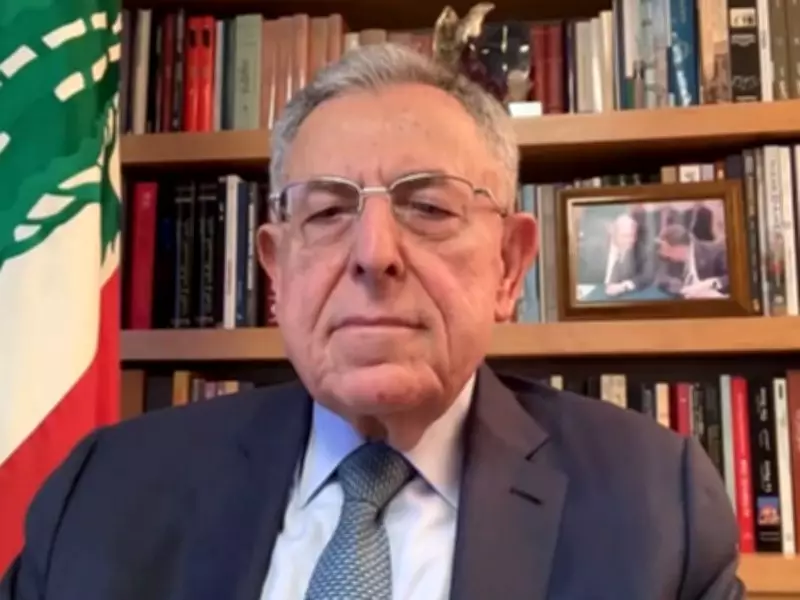
Former Lebanese Prime Minister Fouad Siniora has issued a strong call for the Lebanese state to reclaim its sovereignty, arguing that the country can no longer tolerate an autonomous, armed Hezbollah. His remarks come in the wake of the announced peace deal between the United States and Iran.
Hezbollah's actions unsustainable
Speaking with ANI, Siniora emphasized that the current situation, where Hezbollah initiates hostilities without consulting the legitimate government, is "no longer sustainable." He argued that the path forward requires a decisive shift toward empowering the Lebanese Armed Forces to control the entire national territory.
"Hezbollah can no longer stay as an armed group in Lebanon. The legitimate power in Lebanon, supposedly the Lebanese government, has to be in full force and able to control things. What has been going on is that Hezbollah has been taking the initiative of doing whatever it wants without consulting or getting the approval of the legitimate authority. So, in fact, this situation can no longer be sustainable. It is very important to help Lebanon in doing so," Siniora stated.

Critique of Israeli military approach
Carefully distancing his vision from the current military approach taken by Israel, Siniora suggested that external strikes against the group are counterproductive. He contended that military pressure from Israel actually provides oxygen to Hezbollah's narrative of "resistance."
"The narrative of Hezbollah cannot really succeed if Israel withdraws from Lebanon. As long as Israel is still occupying Lebanon. I mean Israel is helping the narrative of Hezbollah that it is it wants to free Lebanon from the Israeli occupation. I believe these matters cannot be solved this way, that more effort has to be taken by the United States so that this what you call it the two parties who are serving each other, whether the extremists in Iran or the Israelis," he said.
Call for US support to Lebanese state
Siniora urged the international community, particularly the United States, to provide robust support to the Lebanese government and the national army. He stressed that state institutions need the tools to effectively challenge Hezbollah's influence.
"It is very important that the United States really addresses the problem head on by saying that it is very essential to really give more support to the Lebanese to the legitimate Lebanese government and to the Lebanese army so that it can play its role. And at the same time to give the Lebanese government the ability to have proper argument against the arguments of Hezbollah. Because the weapons of Hezbollah did not help in protecting Lebanon or in deterring Israel or even in protecting Hezbollah itself throughout this period," he said.
He added, "What has been going on is that Israel has occupied more lands has killed more people has driven about about 1/5 of the Lebanese population outside their villages and their homes and has created an area of destruction in the region. This doesn't help. This doesn't really leave let the Lebanese find a way of solving their problems."
Domestic reconciliation and persuasion
Beyond immediate military and geopolitical challenges, Siniora highlighted the necessity of a significant domestic reconciliation process aimed at reshaping the political landscape in Lebanon. He emphasized that the government must exert exhaustive effort to reclaim its legitimacy and mandate, while ensuring the Lebanese Armed Forces receive essential resources for national security.
Crucially, Siniora argued that this transition depends on a deliberate campaign of persuasion within the Shiite community.

"There is a lot of let's say work has to be done in order that the Lebanese government would have to put let's say every effort in order to regain respect and to regain authority and that the Lebanese army to really be given the support that it needs to do so. And there is a lot of convincing has to take place let's say in Lebanon so that to convince the Shiite community that the only force that can protect them and that can really let them go back to their villages and towns and that can allow the reconstruction of the south the destroyed part of the south it's only through the Lebanese legitimate government and the authority of the Lebanese state as such. So this is the way how really matters can be resolved," he stated.
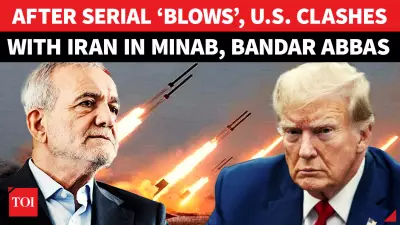
His remarks come as US Vice President JD Vance said on Monday that both sides have already "signed the deal digitally," stressing that any sanctions relief for Tehran as part of the agreement would depend on Iran's compliance with commitments under the agreement. This follows US President Donald Trump's announcement that the deal with Iran was "complete" and will be signed on Friday.