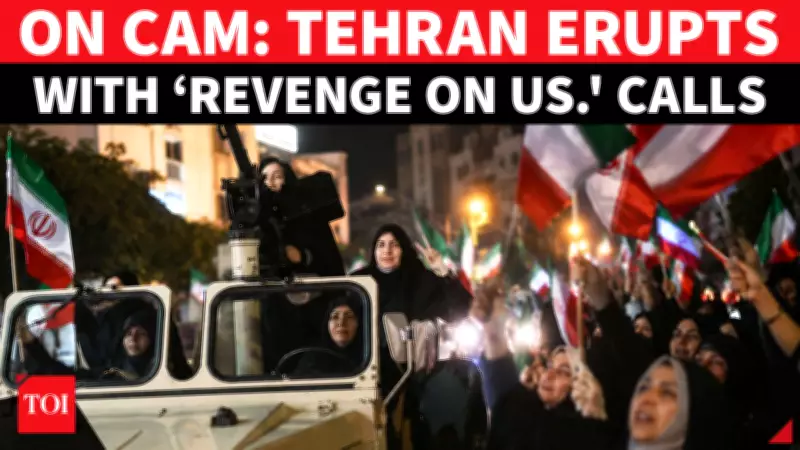
In a significant display of national unity against the United States, thousands of Iranians converged on Tehran's Enqelab (Revolution) Square. Chants directed at the United States echoed across the Iranian capital as the conflict over the Strait of Hormuz and Iran's nuclear program continues to intensify. Iran has persistently leveraged its strategic control over the Strait of Hormuz, one of the world's most crucial oil shipping routes, to exert pressure on global energy markets. Concurrently, clashes and escalating military tensions in the Persian Gulf have heightened fears of a broader regional crisis.
Background of the Conflict
The Strait of Hormuz, a narrow waterway connecting the Persian Gulf to the Gulf of Oman, is a vital chokepoint for global oil shipments. Nearly a fifth of the world's oil passes through this strait, making it a strategic asset for Iran. Tehran has repeatedly threatened to disrupt shipping through the strait in response to international sanctions and military pressure. The latest tensions have been fueled by Iran's advancing nuclear program and the United States' renewed sanctions and military posturing under the Trump administration.
Iran's Nuclear Ambitions
Iran's nuclear program has long been a point of contention with the international community. Despite agreements and inspections, Iran has continued to enrich uranium, raising concerns about its potential to develop nuclear weapons. The United States has demanded that Iran halt all enrichment activities, while Iran insists on its right to peaceful nuclear energy. This impasse has led to a series of diplomatic failures and increasing military readiness on both sides.

Military Posturing in the Persian Gulf
In recent weeks, both the United States and Iran have conducted military exercises in the Persian Gulf. The US Navy has increased its presence, while Iran has deployed fast-attack boats and anti-ship missiles along the coast. These actions have raised the risk of accidental clashes or escalation into a full-scale conflict. Experts warn that any miscalculation could lead to a war that would destabilize the entire region and disrupt global oil supplies.
The Rally in Tehran
Friday's rally in Tehran was organized by the Iranian government to demonstrate popular support for its stance against the United States. Participants waved Iranian flags and held banners condemning US imperialism. Speeches by senior officials emphasized Iran's readiness to defend its sovereignty and interests. The rally also served as a reminder of the 1979 Islamic Revolution, which overthrew a US-backed monarchy and established the current regime.
International Reactions
The international community has expressed concern over the rising tensions. The United Nations has called for restraint and dialogue, while European powers have attempted to mediate. However, the US has maintained its maximum pressure campaign, and Iran has refused to negotiate under the threat of sanctions. The situation remains volatile, with no clear path to de-escalation.
Economic Implications
The standoff has already had significant economic consequences. Oil prices have fluctuated wildly in response to threats to the Strait of Hormuz. Insurance rates for tankers have soared, and some shipping companies have rerouted their vessels. A prolonged conflict could lead to a global recession, as oil-dependent economies face supply disruptions. Iran's economy, already battered by sanctions, would suffer further, but the regime appears willing to bear the cost to maintain its strategic position.
Humanitarian Concerns
Beyond the economic impact, there are serious humanitarian concerns. A war in the Persian Gulf would cause civilian casualties, displace populations, and exacerbate the refugee crisis in the region. The United Nations has warned that a military confrontation could have catastrophic consequences for millions of people. International aid organizations are preparing for the worst, hoping that diplomacy will prevail.
As the situation unfolds, the world watches anxiously. The massive rally in Tehran signals that Iran is prepared for a long confrontation. Whether the United States will back down or escalate remains to be seen. The coming weeks will be critical in determining the future of the region and global security.