The Cold War: A 46-Year Geopolitical Standoff Between Superpowers
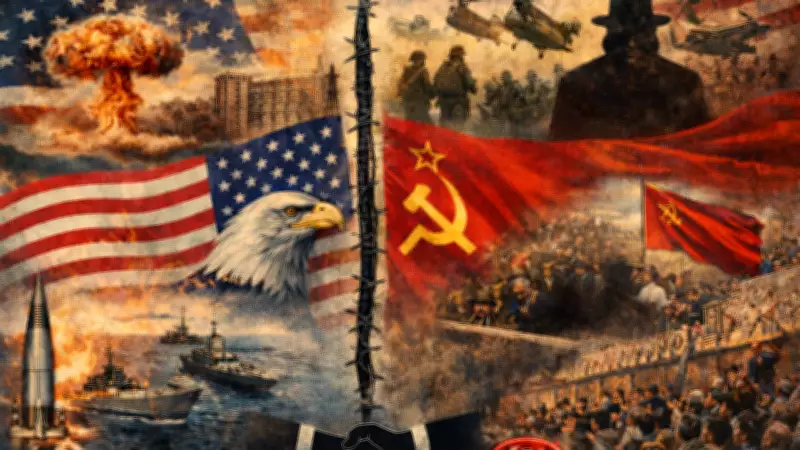
The Cold War represented an extended era of intense geopolitical friction between the United States and the Soviet Union, along with their respective allied nations. This monumental confrontation commenced immediately following the conclusion of World War II and persisted until the dramatic dissolution of the Soviet Union in 1991. Remarkably, despite their profound ideological differences and global competition, the two superpowers never engaged in direct military conflict against one another.
Post-War Tensions and the Formation of Alliances
After their wartime cooperation against Axis powers, relations deteriorated rapidly as the Soviet Union established pro-Soviet governments throughout Eastern Europe and North Korea by 1949. This political division of Europe became famously known as the "Iron Curtain," creating a stark ideological boundary across the continent. The same year witnessed the Soviet Union's successful testing of its inaugural nuclear weapon, dramatically escalating the stakes of the emerging conflict.
The United States responded to perceived Soviet expansion with a series of decisive policies. The Truman Doctrine emerged in 1947, followed by the Marshall Plan in 1948 to support Western European economic recovery. The North Atlantic Treaty Organization (NATO) formed in 1949 as a collective defense alliance, with the Soviet-led Warsaw Pact countering in 1955. Early confrontations included the Berlin Blockade of 1948–49 and the Korean War from 1950 to 1953, which concluded with an armistice rather than a formal peace treaty.

Global Competition and the Cuban Missile Crisis
Both superpowers aggressively sought influence in newly independent states emerging from decolonization processes, frequently providing economic assistance and military support to governments aligned with their respective interests. The 1959 Cuban Revolution brought a communist government to power just 90 miles from American shores, significantly intensifying Washington-Moscow tensions.
The Cuban Missile Crisis unfolded over thirteen extraordinarily tense days from October 16 to 28, 1962, after United States reconnaissance flights identified Soviet missile installations under construction in Cuba. This development occurred while the United States had already deployed nuclear missiles in several allied nations including Italy and Turkey. Soviet leaders, concerned about Cuba's security following earlier tensions between Washington and Havana, had secretly agreed with Cuban authorities in July 1962 to place nuclear missiles on the Caribbean island.
After reviewing surveillance evidence, President John F. Kennedy convened his senior advisers to consider possible responses ranging from diplomatic solutions to military action. He ultimately ordered a naval "quarantine" on October 22 to prevent additional missiles from reaching Cuba, deliberately using that term rather than "blockade," which in international law could imply a formal state of war.
The crisis reached resolution when both sides reached a carefully negotiated agreement: the Soviet Union would remove offensive weapons from Cuba under United Nations verification, while the United States publicly pledged not to invade Cuba. In a separate private understanding, the United States also agreed to remove its missiles from Turkey. By November 20, 1962, the quarantine was lifted following the withdrawal of Soviet missiles and bombers from Cuban territory. This confrontation prompted both nations to establish a direct communication link between their leaders and contributed significantly to subsequent efforts aimed at reducing tensions.
The Final Phase and Conclusion
The period from approximately 1985 to 1991 is widely regarded as the concluding stage of the Cold War. This phase was defined by internal reform within the Soviet Union, reduced tensions between the Soviet-aligned and United States-aligned blocs, the loss of Soviet influence throughout Eastern Europe, and ultimately the USSR's complete dissolution in 1991.

This transformative period began with the rise of Mikhail Gorbachev to general secretary of the Communist Party of the Soviet Union. Seeking to address prolonged economic stagnation associated with the Brezhnev era, he introduced major reforms through his dual programs: perestroika focused on economic restructuring, while glasnost promoted greater political openness and transparency.
Historians differ on the precise date marking the Cold War's conclusion, but there exists broad agreement that several critical developments signaled its end: the signing of nuclear and conventional arms-control agreements, the withdrawal of Soviet military forces from Afghanistan and Eastern Europe, and the final collapse of the Soviet Union in 1991. This marked the conclusion of a 46-year period that reshaped global politics, military strategy, and international relations in profound ways that continue to influence world affairs today.