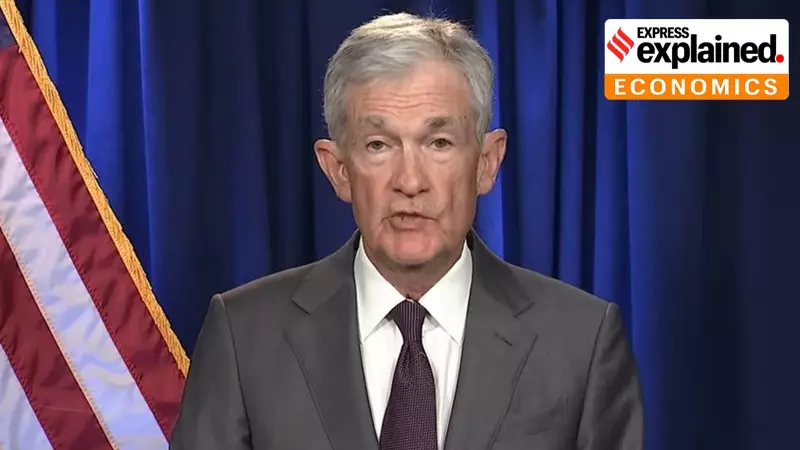
In a dramatic development that threatens the bedrock of central bank independence, Federal Reserve Chairman Jerome Powell revealed he is the subject of a criminal investigation by the US Department of Justice. The unprecedented move, announced by Powell himself in a video message on Sunday, January 11, 2026, marks a severe escalation in the long-running tension between the Fed and President Donald Trump.
An Unprecedented Legal Assault on the Fed
According to Powell's statement, federal prosecutors have served the Federal Reserve with subpoenas and are threatening a criminal indictment. The case revolves around renovations at the Fed's headquarters in Washington, DC, a matter that has been a point of contention. However, Powell framed the investigation not as a legitimate legal inquiry but as a direct consequence of political pressure.
Powell argued that the probe was launched due to the frustrations of US President Donald Trump, stemming from the Fed's refusal to lower interest rates in line with his expectations. "This is about whether the Fed will be able to continue to set interest rates based on evidence and economic conditions, or whether instead monetary policy will be directed by political pressure or intimidation," Powell asserted in his defiant response.

A History of Tension and a Defiant Pushback
The irony is stark: Jerome Powell was first appointed to lead the Fed by Trump himself in 2017. Yet, during Trump's second term, the relationship has deteriorated sharply. The President has repeatedly lambasted Powell for not cutting interest rates fast enough, despite three rate cuts in the latter half of 2025, and has threatened to remove him.
Powell's video message was a calculated act of public resistance. "I have deep respect for the rule of law and for accountability in our democracy. No one, certainly not the Chair of the Federal Reserve, is above the law, but this unprecedented action should be seen in the broader context of the administration's threats and ongoing pressure," he stated.
The investigation will be supervised by the US Attorney's Office for the District of Columbia. When questioned by NBC News on the same Sunday, Trump claimed he did not "know anything" about the Justice Department's investigation, but added, "he (Powell) is certainly not very good at the Fed, and he's not very good at building buildings."
Broader Implications for Global Finance
This event is not an isolated incident but part of a pattern. Trump's administration has previously targeted other Fed officials, including Governor Lisa Cook, whom he tried to fire. That case was blocked by a federal court and is headed to the Supreme Court. Similarly, criminal charges against former FBI Director James Comey were dismissed.
The immediate market context adds to the drama. With inflation projected to rise from early 2026, expectations for a January rate cut remain low. Traders, according to the CME Group's FedWatch tool, now see a 58.3% probability of a cut in March, up from 53.9% the previous week.
Experts view the probe as a dangerous precedent. Ian Bremmer of the Eurasia Group commented, "Political loyalty to President Trump the decisive factor for the US attorney's office, not rule of law." David Folkenflik of NPR called it an "Extraordinary assertion of independence" by Powell.
The chilling message for the world is clear: the long-cherished independence of the US Federal Reserve, a pillar of global financial stability, is under direct assault. This could force the central bank to recalibrate its future policy decisions under the shadow of political intimidation, with ripple effects destined to impact economies and markets far beyond American shores.