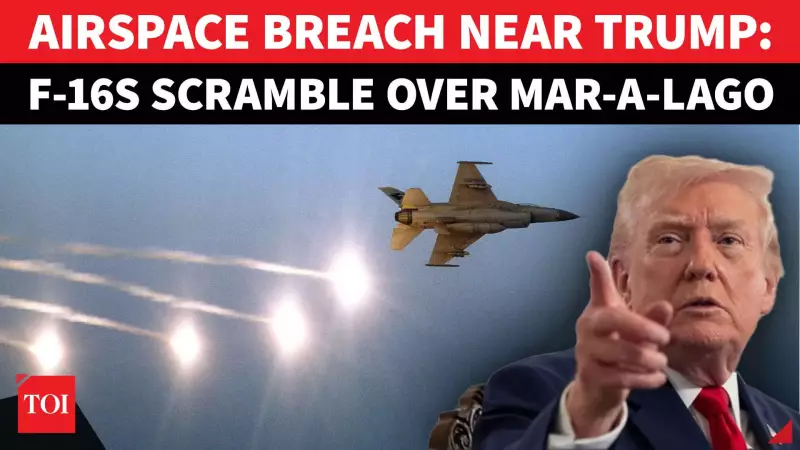
For the second time in a week, United States air defence forces were forced into action to secure the skies around former President Donald Trump's Florida residence. In a dramatic incident on Saturday, North American Aerospace Defense Command (NORAD) scrambled F-16 fighter jets to intercept a civilian aircraft that had entered the temporarily restricted airspace near the Mar-a-Lago club in Palm Beach.
High-Speed Interception Over Palm Beach
The security breach occurred at approximately 4:20 p.m. Eastern Standard Time. Upon detecting the unauthorized entry, NORAD controllers immediately launched the alert fighters. The F-16s, operating at high speed, raced to the location and identified the rogue aircraft. Official reports state that the fighter pilots deployed safety flares as a visual signal to alert the civilian pilot of the violation and to instruct them to leave the protected zone.
NORAD was quick to reassure the public that the flares were a standard safety procedure. A statement clarified that the pyrotechnics burned out quickly and did not pose any danger to people or property on the ground. After establishing communication and ensuring compliance, the fighter jets escorted the aircraft out of the restricted airspace. The incident was resolved without further escalation.

A Pattern of Concerning Violations
This event was not an isolated one. It followed multiple similar breaches of the Mar-a-Lago no-fly zone earlier in the same week, highlighting an ongoing security challenge. Authorities have noted a significant number of incursions in the area over the years. Since 2017, officials have recorded over 40 “tracks of interest” in the sensitive airspace surrounding the former president's home.
The timing of this latest interception is notable. Donald Trump was present at Mar-a-Lago during the incident, having travelled to the Palm Beach estate for the Thanksgiving holiday. The presence of a protectee invariably raises the alert level and the urgency of response for security agencies like NORAD and the Secret Service.
Security Protocols and Public Safety
The repeated violations put a spotlight on the robust but frequently tested air defence protocols protecting sensitive locations in the United States. The swift response by NORAD demonstrates the constant vigilance maintained, even for temporary restricted zones. Such zones, known as Temporary Flight Restrictions (TFRs), are routinely established around the movements and locations of high-profile government figures.
While the identity and intent of the civilian pilot involved in Saturday's event were not immediately disclosed, such breaches are typically treated as serious matters. They can result in steep fines, license revocation, and potential criminal investigation by agencies like the Federal Aviation Administration (FAA) and the FBI, depending on the circumstances. The incident serves as a stark reminder to all pilots of the critical importance of checking for active TFRs before every flight.
The seamless coordination between ground control, radar operators, and fighter pilots ensured this security scare ended safely. However, the recurring nature of these incursions near Mar-a-Lago guarantees continued scrutiny on the effectiveness of airspace protection measures around politically significant sites.