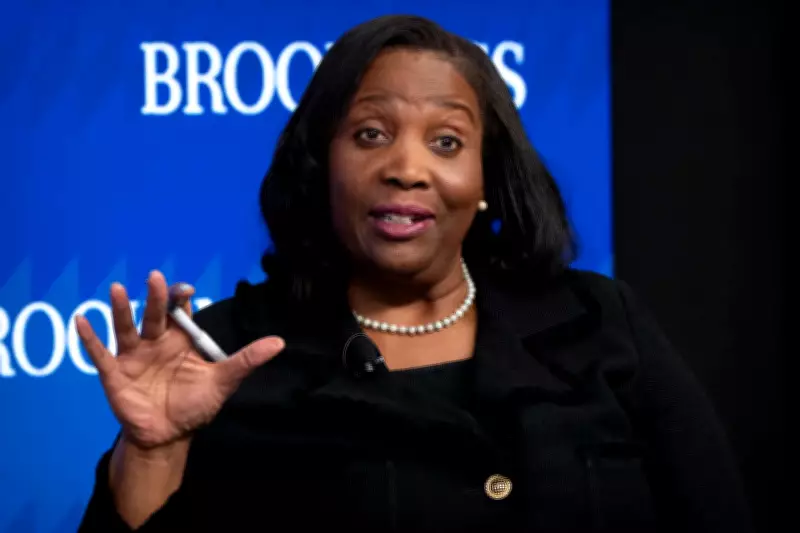
Federal Reserve Governor Lisa Cook Issues Warning on AI's Labor Market Impact
Federal Reserve Governor Lisa Cook delivered a significant caution on Tuesday, stating that artificial intelligence is beginning to fundamentally reshape the United States labor market. Her remarks, presented at a national association for business economics conference, highlighted that these changes could drive unemployment rates higher and potentially limit the effectiveness of the central bank's traditional monetary policy tools, such as interest rate cuts.
"Most Significant Reorganization of Work in Generations"
Cook emphasized that the economy appears to be approaching what she described as "the most significant reorganization of work in generations." She pointed to observable shifts, including transformations in computer coding roles and the increasing difficulties some workers face in securing entry-level positions. While AI is anticipated to create new opportunities over the long term, Cook warned that the transition period is likely to be uneven and disruptive.
"In the early stages, job displacement may precede job creation, such that the unemployment rate may rise and participation in the labor force may decline as the economy transitions," Cook stated. This initial phase of displacement could lead to a measurable increase in unemployment before new AI-driven roles emerge to absorb the workforce.

Monetary Policy Faces New Constraints
The Fed governor outlined a critical challenge for policymakers. In a productivity surge driven by AI, a rise in unemployment might not signal increased economic slack in the traditional sense. "As such, our normal demand-side monetary policy may not be able to ameliorate an AI-caused unemployment spell without also increasing inflationary pressure," Cook explained, as cited by Reuters.
This scenario presents a difficult trade-off: monetary policymakers could be forced to choose between addressing higher unemployment and controlling inflation. Cook suggested that education, workforce development, and other non-monetary policies might be better equipped to tackle these structural labor market challenges in a more targeted manner, without exacerbating price pressures.
Uncertainty Surrounding the Neutral Rate of Interest
Cook also highlighted significant uncertainty regarding how massive AI investment could influence the neutral rate of interest—the theoretical rate that neither stimulates nor restrains the economy. A near-term surge in spending on AI technology and infrastructure could push this neutral rate higher, potentially necessitating tighter monetary policy to keep inflation in check.
Conversely, over a longer horizon, the neutral rate could fall if the economic benefits of AI disproportionately accrue to higher-income groups or if the technology exacerbates existing income inequality. This dynamic adds another layer of complexity to the Federal Reserve's future policy decisions.
Ongoing Debate Within the Federal Reserve
Governor Cook's comments underscore the active and evolving discussion within the Federal Reserve regarding AI's broad economic implications. While some policymakers remain optimistic about the potential for substantial productivity gains that could support lower interest rates over time, others, like Cook, are increasingly focused on the immediate risks.
These concerns include potential labor market disruption, short-term inflationary pressures from a wave of corporate investment in AI, and the limitations of conventional monetary tools in addressing structural economic shifts. The debate highlights the Fed's need to adapt its analytical frameworks to account for the transformative, yet uncertain, impact of artificial intelligence on the US economy.