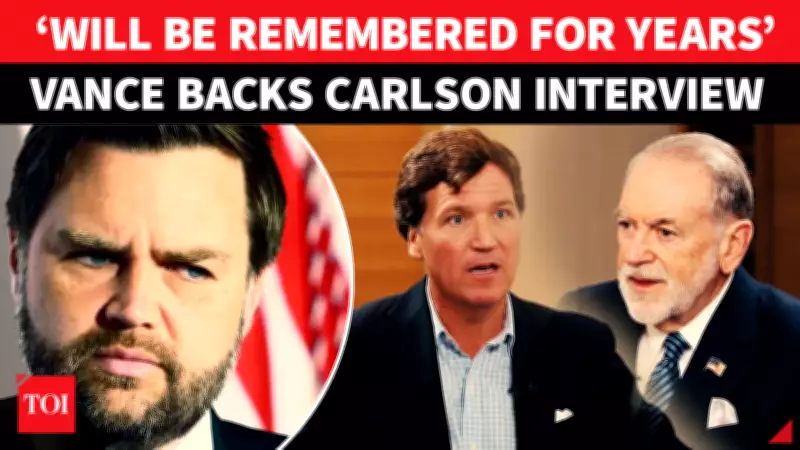
Vice President JD Vance Endorses Tucker Carlson's Controversial Interview
In a significant political development, United States Vice President JD Vance has publicly praised conservative commentator Tucker Carlson's recent interview with US Ambassador to Israel Mike Huckabee. This endorsement comes as the Republican Party experiences deepening internal divisions regarding its stance on Israel and broader foreign policy priorities.
A Heated Exchange Sparks Necessary Debate
Vance characterized the fiery discussion between Carlson and Huckabee as "a necessary exchange for the political right," despite the controversy surrounding both participants. The interview featured Huckabee making contentious remarks about Israel's geopolitical position, while Carlson presented disputed claims that have drawn criticism from various quarters.
The vice president argued that such debates ultimately strengthen what he calls the "Trump coalition" as the party prepares for upcoming elections. This perspective suggests that internal disagreements, when properly channeled, can unify rather than divide conservative voters.

Growing Republican Rifts Over Israel Policy
The interview has exposed significant fault lines within the Republican Party that are becoming increasingly difficult to ignore:
- Traditional pro-Israel conservatives who maintain unwavering support for the nation
- Rising isolationist voices questioning America's traditional foreign policy commitments
- Generational differences in how younger and older Republicans view international engagement
- Strategic disagreements about how best to advance American interests abroad
This clash represents more than just a temporary disagreement—it signals fundamental shifts in Republican foreign policy thinking that have been developing for several years.
The Evolution of Conservative Foreign Policy
The current debate highlights how Republican foreign policy priorities are evolving in response to changing global dynamics and domestic political considerations. What was once a relatively unified position on international affairs has become increasingly fragmented, with competing visions for America's role in the world.
Vance's endorsement of the Carlson-Huckabee interview suggests that some Republican leaders see value in airing these differences publicly, rather than maintaining a facade of unity that might mask deeper disagreements. This approach represents a departure from traditional party discipline and reflects the changing nature of conservative politics in the United States.
Political Implications for Future Elections
The vice president's comments indicate that Republican strategists believe engaging in these difficult conversations will ultimately benefit the party electorally. By allowing different factions to express their views, the party may be able to:
- Identify common ground among seemingly disparate positions
- Develop more nuanced policy approaches that reflect diverse perspectives
- Energize different segments of the conservative base
- Present a more authentic image to voters tired of political uniformity
As the 2026 midterm elections approach and attention turns to the 2028 presidential race, these internal debates will likely intensify, with the Israel question serving as a proxy for broader disagreements about America's global role.
The Carlson-Huckabee interview and Vance's subsequent praise have brought these simmering tensions to the surface, ensuring that foreign policy will remain a central point of discussion within Republican circles for the foreseeable future.