

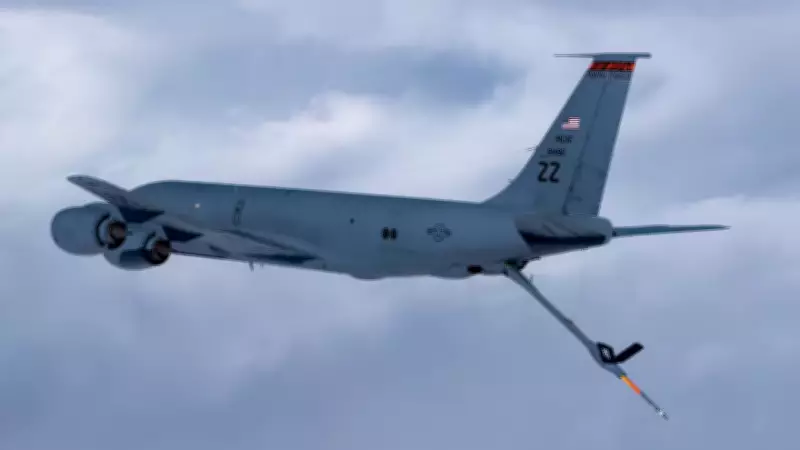
KC-135 Stratotanker: The Enduring Backbone of US Air Force Aerial Refueling
For over six decades, the KC-135 Stratotanker has served as the fundamental pillar of the United States Air Force's aerial refueling capabilities. This aircraft enables fighter jets, bombers, and various other military planes to remain airborne for extended durations and operate across immense global distances. Designed primarily for mid-air refueling missions, the tanker is a critical asset that enhances the range and endurance of US and allied air operations, thereby supporting power projection and sustained missions worldwide.
Recent Incident Highlights Operational Risks
The KC-135 recently garnered significant attention following a tragic crash in western Iraq on March 12. According to the US Central Command (CentCOM), all six crew members aboard the refueling aircraft were confirmed deceased. The incident occurred during Operation Epic Fury while the plane was flying over friendly airspace. Initial reports had indicated four fatalities as rescue efforts were ongoing. Another aircraft was involved in the event, but the US military clarified that it was not caused by hostile or friendly fire.
In an official statement, CentCOM noted, "One of the aircraft went down in western Iraq, and the second landed safely. This was not due to hostile fire or friendly fire." This crash represents another loss of a US aircraft in Iraq amid the evolving Middle East situation, which includes coordinated American-Israeli strikes on Iran that commenced in late February.

Core Mission and Versatile Roles
The KC-135 Stratotanker plays a central role in facilitating extended airborne operations for US and allied aircraft. Its primary function is aerial refueling, supporting not only Air Force units but also aircraft from the US Navy, Marine Corps, and allied nations. Beyond refueling, this versatile platform can transport passengers and cargo, and it is equipped for aeromedical evacuation missions. Using patient support pallets, it can carry both litter and ambulatory patients, showcasing its adaptability in various operational scenarios.
Technical Capabilities and Performance Metrics
Powered by four turbofan engines mounted under 35-degree swept wings, the KC-135 can achieve a maximum gross takeoff weight of up to 322,500 pounds. The aircraft features a cargo deck positioned above the refueling system, allowing it to carry passengers and cargo simultaneously. Depending on its configuration, the tanker can transport up to 83,000 pounds of cargo and accommodate as many as 37 passengers.
In terms of performance, the KC-135 reaches speeds of approximately 530 miles per hour at an altitude of 30,000 feet and can operate at heights up to 50,000 feet. It has a range of about 1,500 miles when carrying 150,000 pounds of transfer fuel, and on ferry missions, it can travel up to 11,015 miles. The maximum transfer fuel load capacity is 200,000 pounds. A standard crew typically includes a pilot, co-pilot, and boom operator, with some missions requiring an additional navigator. For aeromedical evacuations, the crew expands to include two flight nurses and three medical technicians.
Historical Development and Modern Upgrades
The Stratotanker's design originates from the Boeing Model 367-80, which also served as the foundation for the Boeing 707 passenger aircraft. The US Air Force initiated its fleet with the purchase of 29 aircraft in 1954, eventually expanding to a total of 732 tankers. The first KC-135 took flight in August 1956, with the initial production aircraft delivered to Castle Air Force Base in California in June 1957. The final delivery occurred in 1965.
Over the years, many of the original KC-135A models have been upgraded with new CFM-56 engines from CFM-International. The resulting KC-135R and KC-135T variants offer significant improvements: they can offload 50% more fuel, are 25% more fuel-efficient, cost 25% less to operate, and are 96% quieter than their predecessors. Another modified version, the KC-135E equipped with TF-33-PW-102 engines, remained in service until its retirement in 2009.

Adaptations for Specialized Missions
The KC-135 platform has been adapted for numerous specialized roles throughout its service history. Some variants have functioned as airborne command posts, while others have been converted for reconnaissance and testing programs. For instance, the RC-135 is utilized for special reconnaissance missions, and the NKC-135A, operated by Air Force Materiel Command, supports testing initiatives. The OC-135 serves as an observation platform for Air Combat Command in compliance with the Open Skies Treaty.
Ongoing upgrades for the KC-135R and KC-135T variants include enhancements to communication, navigation, autopilot, and surveillance systems to meet evolving air traffic control requirements. Currently, Air Mobility Command manages a fleet of 396 KC-135 Stratotankers. This fleet comprises 153 aircraft operated by active-duty forces, 171 flown by the Air National Guard, and 72 operated by the Air Force Reserve, collectively supporting the command's global mission.





