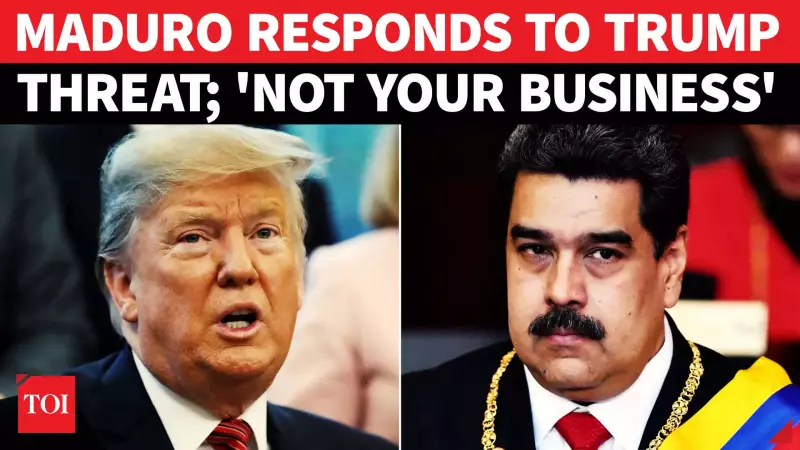
Venezuelan leader Nicolas Maduro delivered a sharp, one-line rebuke to former US President Donald Trump, advising him to concentrate on domestic American problems instead of issuing threats against Caracas. This fiery exchange marks a significant escalation in the long-standing tensions between the United States and the South American nation.
The Ultimatum and the Retort
The diplomatic spat intensified after Donald Trump ordered US naval forces to establish a blockade around Venezuela. Following this aggressive move, Trump publicly attacked Maduro, suggesting it would be a "smart" decision for the Venezuelan president to step down from power. He further accused the Caracas government of intentionally allowing criminals, prisoners, drug dealers, and mentally ill individuals to cross into the United States through what he described as an open border.
President Maduro did not hold back in his response. On December 23, 2025, he fired back with a concise yet powerful statement. Maduro asserted that Trump would be "better off" directing his attention and efforts toward resolving internal issues within the United States rather than threatening Venezuela. This retort underscores Maduro's defiance in the face of mounting pressure from Washington.

Background of the Escalating Conflict
This latest confrontation is not an isolated incident but part of a broader campaign by the US against the Venezuelan government. The situation has gained a complex geopolitical dimension with other global powers taking sides. Reports indicate that Russian President Vladimir Putin and Chinese leader Xi Jinping have rallied behind Venezuela, offering their support against the American campaign. This international backing likely emboldened Maduro's strong response to Trump's ultimatum.
The US strategy appears to involve presenting Maduro with two clear options, though the specifics were implied in the broader context of Trump's statements: either relinquish power or face continued and increased military and economic pressure. The deployment of naval forces for a blockade represents a tangible step in this coercive approach.
Implications and Regional Stability
The order for a US naval blockade and the subsequent war of words have serious implications for regional stability in the Caribbean and South America. A military blockade is typically considered an act of war under international law, signifying a drastic hardening of the US stance. Maduro's warning of a potential 'GLOBAL WAR', mentioned in related reports following Venezuela's seizure of a second oil tanker in the Caribbean Sea, highlights how local tensions could spiral into a wider conflict.
For the Indian audience, this standoff is crucial to monitor as it affects global oil markets and exemplifies the shifting alliances in a multipolar world. The involvement of major powers like Russia and China transforms a regional issue into a test of geopolitical influence, with potential ripple effects on international diplomacy and trade.
The situation remains fluid, with Maduro showing no signs of backing down and the US demonstrating a willingness to use military force. The world now watches to see if this exchange of words leads to further escalation or if diplomatic channels can be reopened to de-escalate the crisis.