Newly Emerged Footage Captures Tragic Mid-Air Collision at Washington Airport
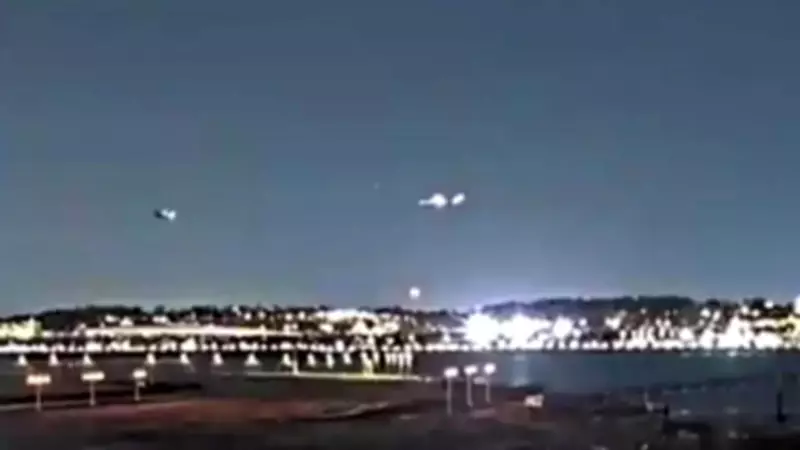
A newly released video has surfaced showing the precise moment an American Airlines passenger jet collided with a United States Army Black Hawk helicopter in mid-air at Ronald Reagan Washington National Airport last year. The footage, shared by the television program 60 Minutes, captures the catastrophic incident with plumes of smoke rising and flames erupting as the two aircraft struck each other.
Details of the Fatal Aviation Accident
The tragic crash occurred on January 29 of last year, resulting in a total of 67 fatalities. This included 64 passengers and crew members aboard the American Airlines jet and three soldiers who were on the Black Hawk helicopter. The passenger aircraft was identified as American Airlines Flight 5342, a Canadian-made Bombardier CRJ-701 twin-engine plane.
At the time of the collision, the jet was inbound from Wichita, Kansas, and was flying at approximately 400 feet over the Potomac River at a speed of roughly 140 miles per hour. On that same day, the Black Hawk helicopter, with the call sign PAT25, was conducting a routine training mission through restricted airspace near the airport.

Safety Reforms and Regulatory Changes Implemented
In the aftermath of this devastating crash, the Federal Aviation Administration (FAA) implemented significant safety changes to prevent similar incidents. These measures included restricting helicopter traffic in the vicinity of Ronald Reagan Washington National Airport and moving certain flight routes farther away from commercial flight paths.
Transportation Secretary Sean Duffy announced that more than $12 billion has been secured to overhaul the national air traffic control system. FAA Administrator Bryan Bedford described the collision as a "sobering reminder" of the critical importance of ongoing safety reforms in aviation.
Historical Context and Lasting Impact
This mid-air collision remains the deadliest such incident in the United States since November 12, 2001. The newly emerged video provides a stark visual record of the tragedy, highlighting the catastrophic consequences when aircraft paths intersect unexpectedly.
The footage serves as both a memorial to those who lost their lives and a powerful tool for aviation safety advocates pushing for continued improvements in air traffic management and collision avoidance systems.