

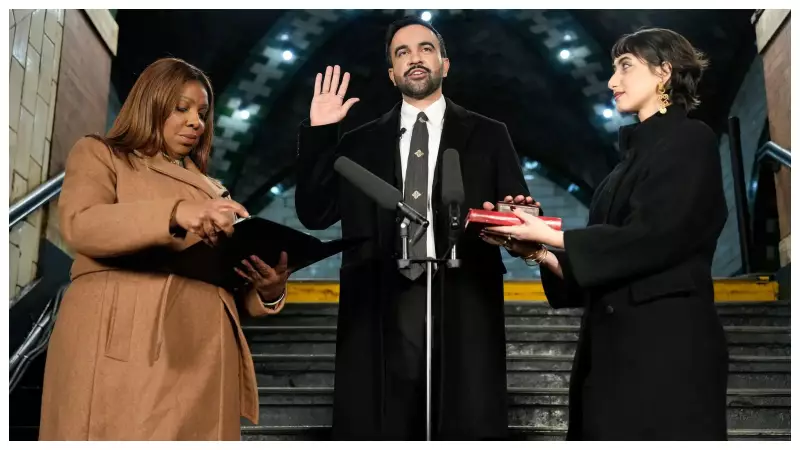
In a striking departure from the political norm, Zohran Mamdani used his inaugural address as New York's Mayor not to temper expectations but to dramatically raise them. The speech, delivered with unapologetic clarity, directly challenged the cautious, constraint-focused governance that has defined the city for years. Mamdani, a self-described democratic socialist, framed his mayoralty as a decisive break from the past, prioritising bold ambition over managed decline.
A Clear Break from the Politics of Caution
Mamdani began by explicitly rejecting the traditional advice given to new leaders. He refused to ask New Yorkers to "ask for little and expect even less." This opening salvo set the tone for an administration that promises visible effort and confrontation over quiet restraint and incrementalism. The Mayor signalled that his governance would not be pre-emptively limited by timidity, marking his clearest ideological break from recent administrations that often treated boldness as irresponsibility.
The core of his philosophy rests on the unapologetic use of state power. In a direct rebuttal to the post-1990s consensus, Mamdani declared that City Hall would no longer hesitate to wield its authority to improve lives. This foreshadows a period of regulatory fights and public provision policies designed to test the limits of municipal power, moving away from a culture of deference to market forces.

Concrete Promises: Immediate Relief and Public Provision
While light on intricate implementation details, the speech was heavy on directional promises aimed at delivering tangible, immediate cost relief. Mamdani outlined several key pillars of his agenda, each framed as correcting a daily indignity that government has wrongly normalised.
Free and Fast Buses: He promised that riding a bus without worrying about fare hikes or delays would cease to be a "small miracle." This policy is positioned not just as a transport reform but as a universal relief measure. The political logic is potent: once a fare disappears, its return would require public justification, shifting the burden of proof onto opponents.
Universal Childcare: Framing it as freedom from economic coercion, Mamdani pledged to deliver universal childcare funded by taxing the wealthiest few. He deliberately avoided framing it as merely a labour-market tool, instead presenting it as essential infrastructure that liberates life choices, like starting a family, from financial pressure.
Rent Freeze: Perhaps the most legally complex promise, Mamdani vowed a freeze for rent-stabilised homes. Aware of the constraints from state law and powerful landlord interests, this promise appears designed to force a political confrontation. If blocked, the focus would shift from inevitability to obstruction, exposing where real power over housing lies.
Redefining Safety and Governing Culture
On public safety, Mamdani avoided polarising abolitionist rhetoric. Instead, he proposed a functional correction: a new Department of Community Safety to handle mental health crises, allowing police to focus on their core duties. This reframing aims to appeal to communities affected by over-policing and voters concerned about order simultaneously.
Perhaps the most operationally significant pledge was to transform City Hall's culture from one of "no" to one of "how?". This shift demands that bureaucracies and obstructing entities justify their resistance publicly, making limits visible rather than quietly accepted. Mamdani bets that even policy failures can be politically useful if they clarify where power is blocked.
The Underlying Philosophy: Collectivism as Civic Identity
Connecting these policies is a clear governing logic. Mamdani called for replacing "the frigidity of rugged individualism with the warmth of collectivism." In his vision, free buses, childcare, and rent freezes are shared infrastructure that reduce individual coping costs and private improvisation for survival.

He also redefined what it means to be a New Yorker, subordinating cultural differences to a shared civic identity forged by common material struggles—high costs, long commutes, and housing insecurity. This allows him to argue for universal policies as a right owed to all residents based on their shared condition, not their specific group identity.
In his closing, Mamdani offered no ideological softening, stating plainly, "I was elected as a democratic socialist and I will govern as a democratic socialist." This line serves as narrative discipline, locking in expectations early to avoid future accusations of bait-and-switch politics.
The bottom line is unmistakable. Zohran Mamdani's inaugural address is a declaration of confrontational intent, not a detailed blueprint. He is betting that New Yorkers are more fatigued by cautious realism than by the risks of bold overreach. His administration intends to be judged not by how well it manages constraints, but by how hard it pushes against them.





