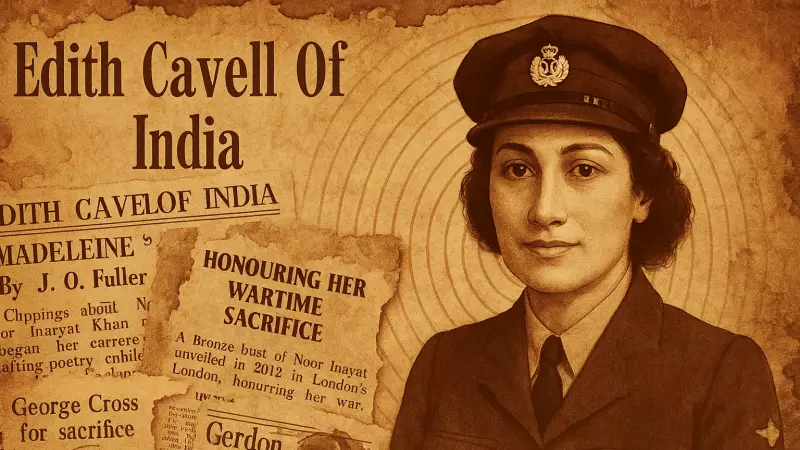
In the annals of World War II history, few figures are as remarkable and unlikely as Noor Inayat Khan. A woman of Indian descent, trained in classical music and child psychology, she became one of the most vital and courageous wireless operators for the British in Nazi-occupied France. Her story, long celebrated for its bravery, has recently been honoured by France with a commemorative postage stamp, reigniting interest in her extraordinary legacy.
From Poet to Secret Agent
Noor Inayat Khan's background was far from the typical profile of a wartime spy. Born to an Indian Sufi father and an American mother, she was a direct descendant of Tipu Sultan, the 18th-century ruler of Mysore. Her early life was steeped in art and spirituality. She was a talented writer, composing poetry and enchanting children's stories in both English and French, and held a degree in child psychology.
Yet, when war engulfed Europe, this gentle creative spirit felt a powerful call to action. Driven by a fierce opposition to the Nazi regime, she joined the British Women's Auxiliary Air Force (WAAF) and later was recruited into the Special Operations Executive (SOE), a secret British organisation formed to conduct espionage and sabotage behind enemy lines.

The Dangerous Mission as 'Madeleine'
In June 1943, Inayat Khan, then in her late twenties, took an extraordinary step. She was deployed into Nazi-occupied France as a wireless operator, becoming the first woman sent by the UK to perform this perilous role in that theatre of war. Her codename was 'Madeleine.'
Operating in Paris, her job was to maintain a fragile communication link between the French Resistance networks and London. The role was incredibly dangerous; Nazi detection vans constantly patrolled, hunting for illegal radio transmissions. Capture was almost always followed by torture and execution. Despite the imminent threat and the collapse of her network shortly after her arrival, Noor Inayat Khan chose to remain at her post, single-handedly becoming a critical lifeline for the Resistance.
To her comrades in the French Resistance, she was a ghostly, enigmatic presence—a figure who would appear to transmit messages and then vanish without a trace, earning a reputation for elusiveness.
A Legacy of Ultimate Sacrifice
Her luck ran out in October 1943, when she was betrayed and arrested by the Gestapo. Despite enduring brutal interrogation and repeated escape attempts, she revealed nothing of value to her captors. Classified as a highly dangerous prisoner, she was transferred to the Dachau concentration camp in Germany. There, on September 13, 1944, Noor Inayat Khan was executed. She was just 30 years old.
For her unparalleled courage and sacrifice, she was posthumously awarded the George Cross, the United Kingdom's highest award for gallantry not in the face of the enemy, and the French Croix de Guerre.
The recent issuance of a commemorative postage stamp by France serves as a powerful, lasting tribute. It ensures that the story of this Indian-origin heroine—the musician and writer who became a spy, gave the Nazis a formidable challenge, and laid down her life for freedom—continues to inspire future generations across the world.