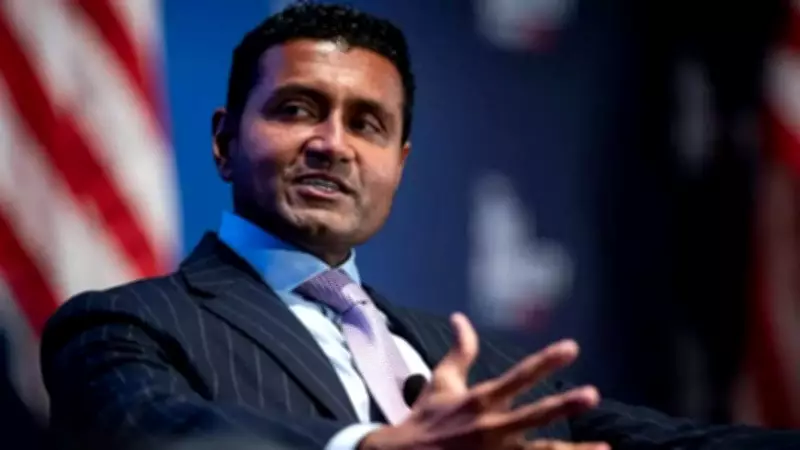
Shyam Sankar: The Palantir CTO on a Mission to Re-arm Western Democracies
"If it wasn't for the grace of God and America, I would be dead in a ditch in Lagos." These powerful words from his father have shaped the life and mission of Shyam Sankar, the Indian-origin Chief Technology Officer at Palantir and a Lieutenant Colonel in the US Army Reserve. For Sankar, the critical task of our time is to rearm Western democracies, and he is pursuing this goal with relentless determination through artificial intelligence.
A Book Born from Urgency
The 43-year-old executive at one of America's most successful data analytics firms is preparing to publish his book 'Mobilize: How to Reboot The American Industrial Base and Stop World War III'. In an interview with The Times, Sankar described his work as a celebration of "crazy dudes" who have overcome oppressive defense procurement bureaucracy to strengthen Western military capabilities.
"Will we look back at this moment and realize that World War III had already started, and we just didn't know it?" he writes in the book's opening, capturing the urgency that drives his work. This question reflects his deep concern about current global tensions and the West's preparedness for potential conflicts.

From Palantir's 13th Employee to Defense Visionary
Shyam Sankar's journey with Palantir began in 2006 when he became the company's 13th employee. Founded by billionaire venture capitalist Peter Thiel, Palantir initially focused on helping institutions combat terrorism after the 9/11 attacks. By 2026, the company had grown to $4.5 billion in annual revenue, working with militaries and enterprises to develop software that enables AI-driven decision-making.
Sankar served as Palantir's first "forward-deployed engineer," working directly on critical missions. One notable operation involved an Islamic State cell in Iraq that planned to use a downed US drone loaded with explosives to attack a hospital. Through Palantir's technology, authorities were able to defeat the ISIS cell before the drone could be launched.
In 2025, Sankar further committed to his vision by becoming a reservist in the US Army, seeking to improve military software and strength from within the institution.
The Immigrant Story That Shaped a Patriot
Sankar's profound dedication to America stems from his family's immigrant experience. Born in Mumbai and raised in Orlando, Florida, his life embodies the quintessential American immigrant narrative. His father was born in a hut in Tamil Nadu, becoming the first in his family to attend college. After running a pharmaceutical factory in Nigeria, the family moved to America following a violent home invasion by armed robbers.
In the United States, the Sankar family operated souvenir and dry-cleaning businesses that eventually went bankrupt. Despite these challenges, Shyam Sankar persevered, earning a Bachelor of Science in Electrical and Computer Engineering and a Master's in Management Science and Engineering from Stanford University.
His career trajectory took him from software developer to Vice President of Network Management at Xoom Corporation and Chairman at Ginkgo Bioworks. Throughout his professional journey, he created opportunities for his family while contributing to his adopted country's development. His father's reminder that "but for the grace of God and America, he would not be alive" continues to resonate deeply with Sankar.
The Urgent Need for Military Modernization
Sankar presents a sobering assessment of America's current military readiness. He warns that in a major conflict, the United States would exhaust critical munitions within a week. The country's military supply chain remains "hopelessly" dependent on China, significantly slowing modernization efforts.
Drawing parallels to historical precedents, Sankar cites Russia's 2022 invasion of Ukraine and China's 2015 militarization of the Spratly Islands as events reminiscent of conflicts that preceded World War II. "These acts were unthinkable if we went back 15 or 25 years... I think you could say that the adversaries were not afraid of the West collectively," he told The Times.

Despite these challenges, Sankar believes catastrophe can be averted through decisive action. He points to encouraging trends, including venture capital funding for US defense technology firms tripling to $5 billion annually according to CB Insights data.
A Blueprint for Defense Transformation
Sankar advocates for a fundamental shift in defense strategy. Rather than planning weapons based on predetermined requirements, he emphasizes building weapons systems responsive to evolving threats. "The US military stockpile scared no one," he reminds readers regarding Russia's attack on Ukraine.
As a self-described "reindustrialization maximalist," Sankar wants every American company to reduce supply chain dependence on China and increase domestic manufacturing. When asked about countries considering alliances with China, he responds pointedly: "I'd say ask [US-captured Venezuelan leader Nicolás] Maduro how good of an ally China was."
The American Aspiration That Drives Progress
What Sankar loves most about America is its "aspiration for greatness"—what he calls a "propelling force" to achieve more, improve continuously, and pursue larger goals. This national characteristic aligns perfectly with his personal mission to strengthen America's defense capabilities through technological innovation.
Through his work at Palantir, his service in the US Army Reserve, and now his book, Shyam Sankar is channeling his family's gratitude for American opportunity into tangible efforts to secure the nation's future. His story represents both the promise of the American dream and the urgent need for Western democracies to adapt to new technological realities in an increasingly complex global security landscape.