

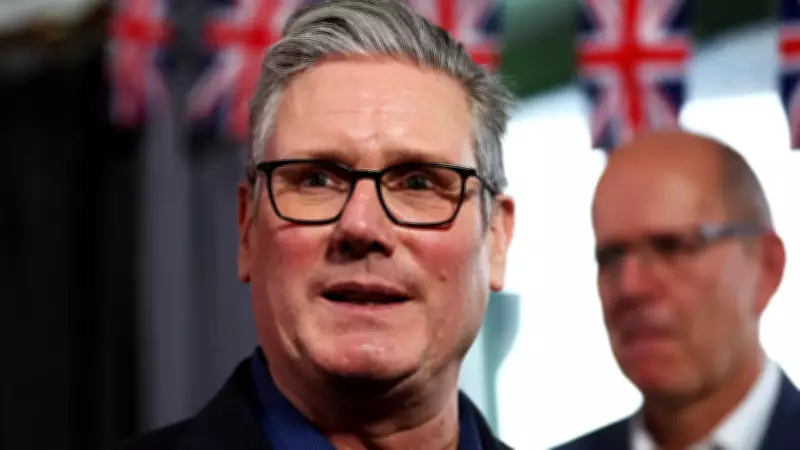
UK Prime Minister Keir Starmer's Communications Director Resigns Amid Escalating Crisis
In a significant blow to the British government, Tim Allan, the director of communications for Prime Minister Keir Starmer, resigned on Monday. This departure intensifies the sense of crisis surrounding Starmer's administration and raises serious questions about his leadership capabilities. Allan, a seasoned political operative with decades of experience, had only joined Starmer's government approximately five months ago, making his exit particularly abrupt and damaging.
Second High-Profile Resignation in Less Than 24 Hours
Allan's resignation follows closely on the heels of Morgan McSweeney, who stepped down as the Prime Minister's chief of staff. McSweeney's departure was directly linked to the controversial ties between Jeffrey Epstein, the convicted sex offender, and Britain's former ambassador to the United States, Peter Mandelson. McSweeney acknowledged that he had urged Starmer to appoint Mandelson to the ambassadorial role in late 2024, a decision that has since sparked a political firestorm.
In a formal statement, Allan explained his decision, stating, "I have decided to stand down to allow a new No. 10 team to be built." He added, "I wish the PM and his team every success." Allan, who is a longtime friend of Mandelson and collaborated with him during Tony Blair's premiership in the 1990s, emphasized the need for a fresh start within the Prime Minister's inner circle.

Mandelson-Epstein Connection at the Heart of the Scandal
The core of this political upheaval revolves around the appointment of Peter Mandelson and his previously undisclosed relationship with Jeffrey Epstein. Recently released documents from the U.S. Justice Department have revealed that Mandelson and Epstein shared a far closer and more prolonged friendship than was publicly known. These files provide damning evidence of their interactions, which include the exchange of confidential and market-sensitive information.
Specifically, the emails indicate that in 2009, while Mandelson was serving in the government, he sent Epstein an internal email intended for then-Prime Minister Gordon Brown. This communication outlined a potential sale of government assets, with Mandelson noting, "Interesting note that's gone to the PM." Furthermore, in May 2010, Mandelson allegedly provided Epstein with advance notice of a 500-billion-euro bailout (approximately $600 billion) agreed upon to address the eurozone crisis. Epstein's response, "Sources tell me 500 b euro bailout, almost complte," was met with Mandelson's confirmation, "Sd be announced tonight."
Additional correspondence suggests that Mandelson sought Epstein's advice on establishing an advisory and consultancy firm, including strategies to attract clients. The emails also imply that Epstein made tens of thousands of dollars in payments to Mandelson, further complicating the ethical and legal implications of their relationship.
Starmer's Response and Political Fallout
Prime Minister Keir Starmer is facing mounting pressure from both critics and allies to disclose what he knew about the Mandelson-Epstein connection at the time of the appointment. Starmer has maintained that Mandelson lied about the extent of his ties to Epstein. In a closed-door speech to his staff at No. 10 Downing Street on Monday morning, Starmer expressed his frustration and regret.
"The thing that makes me most angry is the undermining of the belief that politics can be a force for good and can change lives," Starmer stated, according to a readout provided by political aides. He continued, "I have been absolutely clear I regret the decision that I made to appoint Peter Mandelson. And I've apologised to the victims, which is the right thing to do."
Despite the escalating crisis, Starmer vowed to persevere with the agenda of the Labour Party, which secured an overwhelming majority 18 months ago, ending over 14 years of Conservative Party rule. His aides confirmed in a briefing that the Prime Minister has no intention of resigning. "We go forward from here," Starmer declared in his speech. "We go with confidence as we continue changing the country."

Broader Implications for UK Governance
This scandal threatens to destabilize Starmer's premiership at a critical juncture. The resignations of key staff members, coupled with the revelations about Mandelson's actions, have cast a shadow over the government's integrity and decision-making processes. As the investigation unfolds, the focus will remain on how Starmer navigates this crisis and whether he can restore public trust in his leadership.
The events underscore the challenges facing modern political administrations in maintaining transparency and ethical standards, especially when dealing with figures linked to international controversies. The outcome of this situation could have lasting effects on UK politics and Starmer's legacy as Prime Minister.





