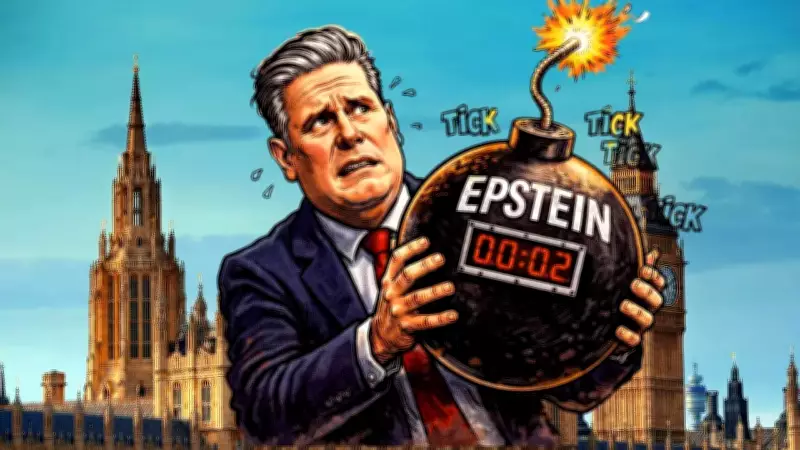
Keir Starmer's Political Identity Confronts Epstein Email Storm
Keir Starmer meticulously constructed his political persona around a single, powerful concept: standards. The former prosecutor pledged to deliver a politics purified of sleaze, indulgence, and ethical shortcuts. This foundational promise now faces its most severe test as the Jeffrey Epstein emails cast a long, ominous shadow over his premiership, functioning like a slow, menacing countdown clock. This unfolding situation does not revolve around concealed crimes or hidden villains. Instead, it constitutes a profound scandal concerning judgment. In the unforgiving arena of politics, lapses in judgment are frequently the very elements that terminate political careers.
The Immediate Trigger of the Political Crisis
The crisis ignited when Prime Minister Starmer made the unprecedented decision to publicly apologize to the victims of Jeffrey Epstein for appointing Peter Mandelson as Britain's ambassador to the United States. This was a remarkable act: a sitting prime minister expressing remorse not for a personal misdeed, but for an official authorization that he knew would reopen traumatic wounds for survivors of one of modern history's most notorious abusers.
Starmer's explanation was both straightforward and devastating. He stated that while he had been cautioned about Mandelson's past association with Epstein, he had been misled regarding the true depth and closeness of that relationship. Upon realizing that Mandelson had significantly downplayed their connection, Starmer removed him from the ambassadorial post and expressed profound regret for having initially placed trust in Mandelson's account.

This singular admission fundamentally transformed the narrative. The focus shifted decisively from Mandelson's actions alone to a critical examination of the Prime Minister's own decision-making process and judgment.
Why the Epstein Emails Pose a Grave Political Threat
The danger of the Epstein emails lies in their methodical, incremental release. They do not arrive as a single, comprehensive dossier but emerge in troubling batches. Names resurface, contexts accumulate, and associations that might appear defensible in isolation begin to look reckless and negligent when viewed as part of a larger, persistent pattern.
Crucially, these emails do not need to prove criminal behavior to inflict significant political damage. Their power stems from their ability to establish familiarity, continuity, and access between public figures and the disgraced financier. In Mandelson's case, each new disclosure fortifies the perception that Epstein was not a distant, casual acquaintance but a recurring and acknowledged presence in his social and professional circles, long after Epstein's criminal conviction.
This perception directly undermines Starmer's primary defence. The Prime Minister's position rests on the narrow claim that Mandelson misrepresented the nature of his relationship with Epstein, and that with full knowledge, the appointment would never have proceeded. As more evidence surfaces suggesting this relationship was widely documented and understood within certain circles, Starmer's defensive stance grows progressively weaker. The emails possess the dangerous capability of transforming what should be a closed chapter into a persistently open and evolving scandal.
A Failure of Judgment, Not Merely a Vetting Failure
Downing Street has attempted to frame this episode as a procedural breakdown—a failure of vetting processes. The official line suggests that due diligence was insufficient, procedures will be tightened, and lessons will be learned.
However, this explanation is incomplete and fails to convince. Mandelson's association with Jeffrey Epstein was not buried in classified intelligence files or obscure archives. It had been publicly reported, widely discussed, and critically questioned for years in media circles. The potential risk was visible; the ensuing controversy was entirely foreseeable.

This reality points to a more damaging conclusion: the central issue is not that Keir Starmer lacked critical information. It is that he chose to discount or overlook readily available information. This distinction is politically fatal. The electorate does not expect their leaders to be all-knowing, but they do expect them to exercise prudent judgment and avoid obviously risky, reputationally toxic appointments—especially when such appointments blatantly contradict the very ethical standards the leader publicly champions.
The Deepening Shadow of Peter Mandelson
The problem intensifies when considering Peter Mandelson's entrenched position within the Labour Party's power structure. He was not a peripheral figure recruited from obscurity. Mandelson was a deeply embedded, influential operator within the party's ecosystem. Numerous advisers, ministers, and strategists in Starmer's inner circle maintain long-standing professional or personal ties to him.
This interconnectedness matters immensely because political scandals rarely remain contained. They possess a tendency to spread through networks of association. Each fresh disclosure from the Epstein trove now raises a cascade of uncomfortable secondary questions:
- Who internally defended Mandelson's appointment?
- Who provided personal or professional assurances on his behalf?
- Who within the Prime Minister's team argued that the associated risk was acceptable or manageable?
Consequently, the Epstein emails threaten not only Starmer's judgment in a single appointment but also cast doubt on the broader culture of decision-making and accountability that surrounds his premiership.
The Calculated Risk of the Public Apology
From a moral standpoint, Keir Starmer's apology to Epstein's victims was undoubtedly the correct course of action. Politically, however, it represented a significant gamble.
Apologies function effectively when they conclusively end a controversy. They fail when the underlying story continues to evolve and new details emerge. With Epstein-related material still periodically surfacing from legal proceedings in the United States, there is absolutely no guarantee that the most damaging revelations are already public knowledge.
Every new batch of emails or documents risks rendering Starmer's apology seem incomplete, premature, or merely reactive. The central question then subtly shifts from 'Was the Prime Minister sorry?' to the more damaging 'Was he sorry early and fully informed enough to have made a different decision?'
Political opponents have been quick to capitalize on this dynamic, strategically framing the entire affair as a fundamental test of leadership instinct and trustworthiness, rather than a narrow legal issue. In the court of public opinion, a prime minister's authority crumbles not necessarily when laws are broken, but when the public ceases to trust his or her core judgment.
The Bigger Picture: A Ticking Political Time Bomb
This is precisely why the Epstein email saga functions as a ticking time bomb rather than a contained, one-off scandal. It operates on a drip-feed model that systematically erodes confidence. Each new release reinforces a vicious and damaging cycle:
- Reconfirmation of a known, problematic association.
- Renewed questions about the Prime Minister's judgment.
- A defensive or explanatory response from Downing Street.
- A gradual, cumulative erosion of political credibility.
Keir Starmer's entire political brand is built upon pillars of control, discipline, and moral clarity. The legacy of Jeffrey Epstein represents the polar opposite: a world of murky relationships, deferred accountability, and endless, unresolved questions.
As long as the Epstein story continues to resurface in public discourse, the narrative surrounding Peter Mandelson never truly concludes. And as long as Mandelson's story lingers, so too does the dark shadow over the Prime Minister who judged this to be an appointment risk worth taking. In British politics, scandals rarely conclude when all facts are established. They end only when public trust is genuinely restored. On the matters of Epstein and Mandelson, that essential trust remains fractured and unresolved. For Keir Starmer, this lingering, unresolved doubt may ultimately prove far more dangerous than the contents of any single email.