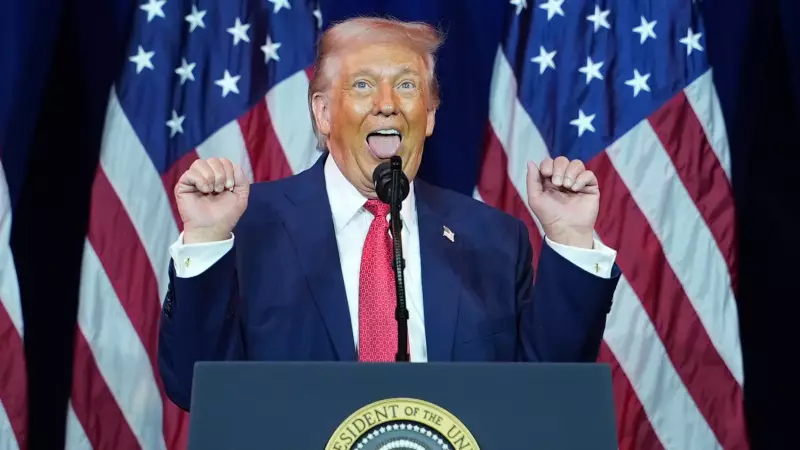
Former US President Donald Trump delivered a sharp critique of NATO allies during a campaign rally in South Carolina, asserting that the United States remains the sole global power capable of instilling fear in rivals like Russia and China. His comments have reignited debates about the future of the transatlantic alliance and America's role within it.
Trump's Provocative Stance on NATO Defence Spending
Addressing supporters, Trump reiterated his long-standing grievance regarding the financial contributions of NATO member nations. He claimed to have told the leader of a "big country" that he would "encourage" Russia to do whatever it wants to allies who are "delinquent" in meeting their defence spending commitments. This stark warning underscores his transactional view of the alliance, where protection is contingent upon monetary payment.
The core of Trump's argument hinges on the NATO guideline that members should spend at least 2% of their Gross Domestic Product (GDP) on defence. He portrayed the US as carrying a disproportionate burden, suggesting that other nations have taken advantage of American generosity for decades. His rhetoric positions the US not as a committed partner, but as a protector for hire, a stance that has consistently alarmed European leaders.

The "Fear" Factor: US Power vs. Global Rivals
In a key segment of his speech, Trump framed global power dynamics in starkly simplistic terms. "The only nation that Russia and China fear is the United States," he declared. This statement, while emphasizing perceived American strength, simultaneously dismisses the collective deterrent power of NATO and the strategic capabilities of other global players.
This perspective aligns with Trump's "America First" philosophy, which often sidelines multilateral cooperation in favour of unilateral assertions of power. By stating that Russia and China fear only the US, he implicitly questions the value and credibility of the NATO alliance as a whole, suggesting that European security ultimately rests on American might alone.
Navalny's Death and Trump's Domestic Political Dig
Trump also briefly addressed the recent death of Russian opposition leader Alexei Navalny, which has been widely condemned by Western leaders. While not assigning direct blame, his remarks quickly pivoted to a comparison with his own legal troubles in the United States.
"It's a horrible thing, but it's happening in our country too," Trump said, drawing a parallel between Navalny's fate and what he characterizes as a politically motivated justice system targeting him. This analogy, equating a death in Russian custody with his indictments, was immediately criticized for false equivalence and for deflecting focus from the actions of the Kremlin.
The rally took place in Conway, South Carolina, on February 10, 2024, as Trump continues his campaign to secure the Republican presidential nomination for the upcoming election. His comments on NATO and global affairs are being closely watched by both allies and adversaries, signaling a potential return to a more confrontational and unilateral US foreign policy should he win another term.
The immediate consequence of such rhetoric is a renewed sense of uncertainty among NATO members. While the alliance has strengthened since Russia's invasion of Ukraine, with more members meeting the 2% spending target, Trump's statements threaten to undermine the fundamental principle of collective defence—Article 5—by making it conditional. This creates strategic anxiety in European capitals and could potentially embolden adversaries who seek to exploit divisions within the Western alliance.