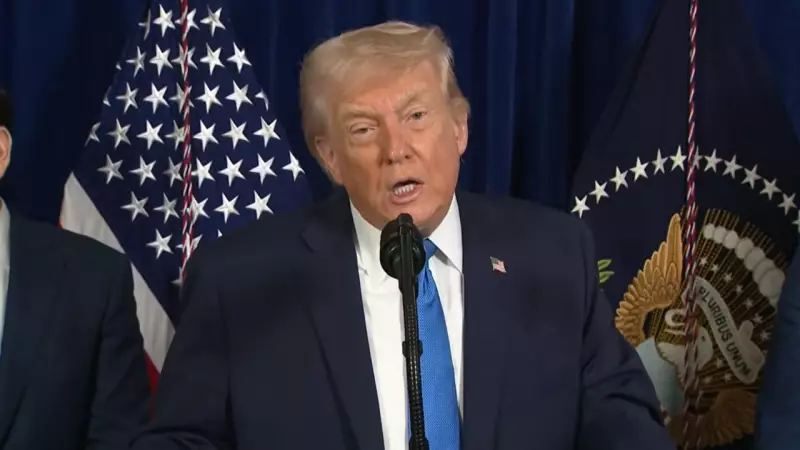
In a dramatic escalation of foreign policy rhetoric, US President Donald Trump has issued a series of stark warnings to nations across the Americas and beyond, following the unprecedented military operation that captured Venezuelan leader Nicolás Maduro. Speaking from Air Force One and in interviews on Sunday, Trump outlined a combative new vision for US dominance, a stance his administration is calling the "Donroe Doctrine."
A Blunt Warning to Latin American Nations
President Trump began his remarks with a blistering attack on Colombian President Gustavo Petro. He accused Petro of overseeing drug production that harms the United States, stating, "Venezuela and Colombia are very sick. A sick man who likes making cocaine and selling it to the United States … And he’s not going to be doing it very long." When questioned about potential US military action in Colombia, Trump cryptically replied, "Sounds good to me."
Turning to Cuba, Trump suggested the island nation was on the brink of collapse following the political upheaval in Venezuela, its former benefactor. "Cuba is ready to fall … Cuba now has no income. They got all of their income from Venezuela… from the Venezuelan oil," he said, implying that direct US intervention might not even be necessary.

Mexico also received a sharp warning regarding drug cartels. Trump insisted the country "has to get their act together" and hinted that Washington could step in if cartels continue to "pour through Mexico."
Global Ambitions: From Iran to Greenland
Trump's confrontational rhetoric was not confined to the Western Hemisphere. He addressed the unrest in Iran, warning that Tehran would be "hit very hard by the US" if it used lethal force against protesters.
In a surprising revival of a past demand, Trump also set his sights on Greenland. He claimed the territory was vital for US national security due to increased Russian and Chinese presence, arguing, "We need Greenland … it’s so strategic right now. Greenland is covered with Russian and Chinese ships all over the place... Denmark is not going to be able to do it." This territorial ambition has long been dismissed by foreign capitals as unrealistic.
The 'Donroe Doctrine': A New Chapter in US Hegemony
President Trump explicitly framed his aggressive stance as a modern, supercharged version of the 19th-century Monroe Doctrine, which declared the Western Hemisphere a US sphere of interest. "The Monroe Doctrine is a big deal, but we’ve superseded it by a lot, by a real lot," Trump declared, embracing the term "Donroe Doctrine." He asserted, "American dominance in the Western hemisphere will never be questioned again."
This reinterpretation is reflected in the National Security Strategy released in late 2025, which prioritizes restoring "American preeminence" in the region. Supporters argue this is a necessary correction after years of perceived US neglect and growing Russian and Chinese influence in Latin America.
The regional and international response has been swift and hostile. Colombian President Gustavo Petro condemned Trump's words as a sovereign threat, rallying Latin American unity. Cuban President Miguel Díaz-Canel denounced the Venezuela operation as "state terrorism." Danish Prime Minister Mette Frederiksen flatly rejected US claims on Greenland, stating the US has no right to annex any part of the Danish kingdom.
Meanwhile, in Venezuela, reports indicate residual pro-Maduro resistance, challenging the US hope of quickly installing a friendly regime in Caracas. Trump warned of "severe consequences" and a potential "second strike" if the interim leadership does not align with US demands, bluntly adding, "We’re in charge."
Critics worldwide see the "Donroe Doctrine" as a dangerous revival of unilateral interventionism that could destabilize regions and alienate allies. As diplomatic tensions flare from Bogotá to Copenhagen, the aftermath of the Venezuela operation has rapidly expanded into a defining test of 21st-century American power and its global limits.