

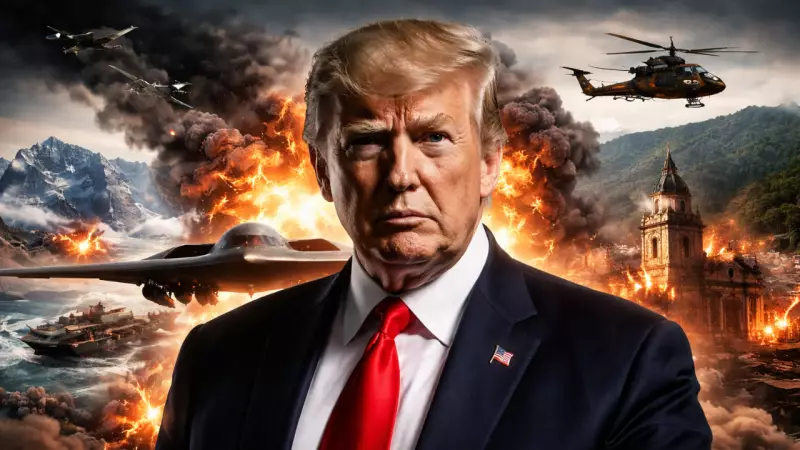
In a paradoxical start to 2026, US President Donald Trump, while championing a 'Peace on Earth' message, unleashed a massive military operation against Venezuela, setting a bellicose tone for his second term. This action underscores a foreign policy where the United States rapidly alternates between roles of mediator, aggressor, and self-appointed global overseer, often dictated by the President's own whims.
The Venezuela Strike and the 'Donroe Doctrine'
Within 48 hours of his New Year peace proclamation, Trump ordered Operation Absolute Resolve, a swift overnight military action that resulted in the capture of Venezuelan President Nicolas Maduro. Maduro was transported to US soil as a prisoner, leaving the nation with the world's largest oil reserves vulnerable to external exploitation.
Trump justified this intervention under a freshly branded 'Donroe Doctrine'—a Trumpian revision of the 200-year-old Monroe Doctrine. He further elaborated a 'Trump Corollary', inspired by Theodore Roosevelt's policy, positioning himself as the unilateral overseer responsible for the Western Hemisphere's 'well-being'.

A Global Pattern of Aggression and Mediation
Venezuela was not an isolated incident but part of a consistent pattern. In June 2025, Trump ordered strikes on Iran's nuclear program. Over the preceding year, US forces also attacked targets in Iraq, Nigeria, Somalia, Syria, and Yemen.
This aggressive stance exists alongside Trump's claims of mediating ceasefires in conflicts like the Russia-Ukraine war, for which he takes credit. He has claimed to settle eight wars, yet his role shifts unpredictably from peacemaker to aggressor, employing deadly assets like B-2 bombers to assert US hegemony.
Nations on Trump's 2026 Radar
Fresh from the Venezuela strike, the Trump administration has identified new potential targets, blending military threat with political and economic pressure.
Greenland: Trump has renewed his push to acquire the semi-autonomous Danish territory, citing defense needs. Danish Prime Minister Mette Frederiksen and Greenland's Premier Jens-Frederik Nielsen have firmly rejected the claim, with Denmark warning its troops will 'shoot first and ask questions later' if Greenland is attacked. The US is reportedly considering a plan to offer Greenlanders cash payments of $10,000 to $100,000 per person to encourage separation from Denmark.
Iran: Widespread protests erupted in Iran in early 2026 following the collapse of the rial and soaring inflation. Trump openly supported the protesters, directly threatening the regime of Supreme Leader Ayatollah Ali Khamenei and warning of hitting them 'very hard'. This follows the 2020 drone strike that killed General Qasem Soleimani and the 2025 Operation Midnight Hammer strikes on Iranian nuclear sites.
Mexico: Trump has repeatedly suggested US military intervention to 'eliminate the cartels,' claiming they are 'running Mexico.' President Claudia Sheinbaum has diplomatically resisted, asserting Mexican sovereignty and ruling out the likelihood of an invasion.
Cuba: Trump stated Cuba is 'ready to fall' after losing Venezuelan oil imports, which constituted 70% of its oil supply. President Miguel Díaz-Canel accused the US of 'fascist state terrorism,' but experts warn the loss of oil has dramatically worsened an existing economic crisis on the island.
Colombia: Trump labeled Colombia 'very sick' and attacked leftist President Gustavo Petro. Petro responded by ordering Colombian soldiers to prioritize the national flag and defend against any attacker. The US may look to influence the upcoming May presidential election to install a friendly government.
Canada: While downplaying immediate plans, Trump has repeatedly mused about making Canada the '51st state', claiming the US subsidizes it by $200 billion a year. His unpredictable nature leaves this a lingering, if distant, concern.

Conclusion: A World on Alert
President Donald Trump's second term has inaugurated a volatile era of US foreign policy. By repackaging century-old doctrines with his own brand and backing them with sudden military force—from Venezuela to the Middle East—he has placed multiple nations across continents on high alert. The dichotomy between his Nobel Peace Prize aspirations and his administration's aggressive actions defines a presidency that continues to keep the world guessing and on edge.





