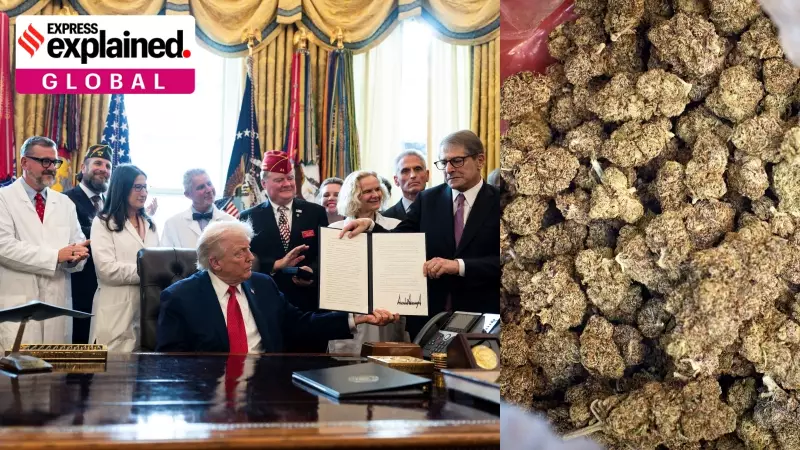
In a landmark move with far-reaching implications, US President Donald Trump signed an executive order on Thursday, December 19, 2025, to reclassify marijuana under federal law. The order shifts cannabis from a Schedule I substance—a category reserved for the most dangerous drugs like heroin and LSD—to the less restrictive Schedule III, which includes prescription painkillers like hydrocodone.
A Turning Point in the Decades-Long Drug War
This decision is widely seen as a major milestone in the multi-decade push to decriminalise and eventually legalise cannabis across the United States. It represents a significant step toward undoing the damage inflicted by the so-called 'War on Drugs' and moving toward a narcotics framework that prioritises public health and treatment over strict enforcement and punishment.
The foundation of this war was laid with the Controlled Substances Act (CSA) of 1970. This law categorised all regulated substances into five schedules. Despite evidence of its relative safety and lower addiction potential compared to other drugs, cannabis was placed in Schedule I alongside heroin. The official 'War on Drugs' was declared by President Richard Nixon on June 17, 1971, initiating a federal crackdown involving prohibition, aggressive law enforcement, and international intervention.

Subsequent administrations, most notably Ronald Reagan's, intensified these efforts. The Reagan era was marked by influential anti-drug campaigns like 'Just Say No', led by First Lady Nancy Reagan, which often relied on fear-mongering. Scholars now agree this approach has been a colossal failure. A 2018 report by the Center for American Progress estimated the cost to the US exchequer at more than $1 trillion. Crucially, it led to mass incarceration without curbing substance abuse rates.
The Stark Racial Disparities of Drug Enforcement
One of the most damning legacies of the drug war is its profound and disproportionate impact on communities of colour. Enforcement of drug laws has consistently exhibited a stark racial bias from the outset.
The case of cannabis arrests is particularly telling. Data from the Drug Policy Alliance and Marijuana Arrest Research Project in 2017 revealed that as recently as 2016, a staggering 92% of all arrests for marijuana possession by the New York City Police involved Black and Latinx individuals. This is despite surveys showing roughly similar levels of cannabis use across racial groups.
The racial animus was reportedly embedded in the policy's design. John Ehrlichman, a close adviser to President Nixon, admitted in a 1994 interview that the administration intentionally linked drugs to anti-war activists and Black communities to criminalise and disrupt them. The consequences are enduring: as of 2018, Black men were nearly six times more likely than white men to be incarcerated, often for minor, non-violent drug offenses.
Advocates like Kassandra Frederique of the Drug Policy Alliance argue that ending the drug war is essential to remove the pretext for law enforcement overreach that has inspired movements like Black Lives Matter.
The Winds of Change and Federal-State Conflict
Even during the height of the drug war, some states recognised the counterproductive nature of cannabis criminalisation. Oregon became the first state to decriminalise minor possession in 1973. The movement gained momentum in the 1990s and 2000s. California legalised medical marijuana in 1996, and Colorado and Washington pioneered recreational legalisation in 2012.
Today, 24 states, two territories, and the District of Columbia have legalised recreational cannabis, while medical use is approved in 48 states. However, a glaring conflict has persisted: federal law continued to classify marijuana as a dangerous Schedule I drug, creating a 'legal black hole' for businesses and individuals in states where it is legal.
Trump's reclassification order is a pivotal move toward harmonising federal policy with state laws and aligning it with overwhelming public opinion. A Pew Research Centre survey from July 2025 found 87% of Americans support legalising marijuana in some form.

While cannabis will remain illegal federally under Schedule III, the reclassification opens doors for expanded medical research. A senior White House official stated the primary goal is to improve research on medical marijuana and CBD to better inform patients and doctors. This executive order is the first federal-level action to formally acknowledge the potential medical value of cannabis, potentially bolstering the case for future full legalisation.