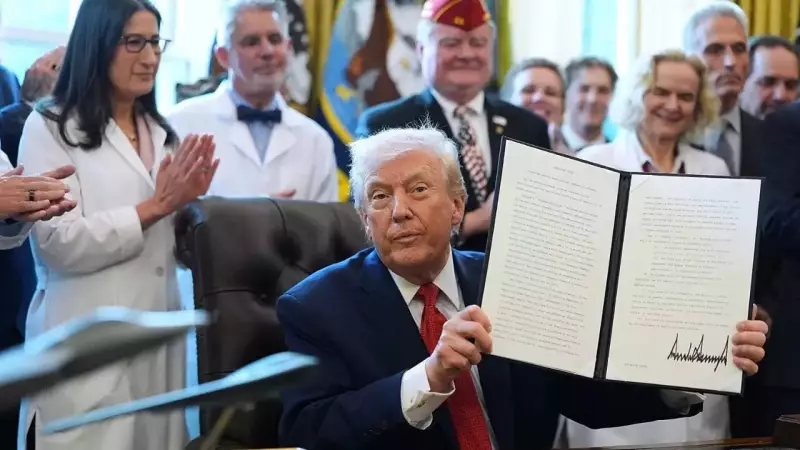
In a significant move to chart America's future in the cosmos, US President Donald Trump has unveiled a sweeping new executive order. This directive lays out a comprehensive roadmap for American space activities for the rest of this decade, aiming to cement US leadership while tightly linking exploration with national security and economic competitiveness.
Lunar Return and Mars Ambition Take Center Stage
The policy sets bold and specific celestial goals. A headline objective is the return of American astronauts to the lunar surface by 2028. This is not envisioned as a fleeting visit but as a prelude to establishing a permanent human outpost on the Moon by 2030. This shift signals a move from short-term expeditions to a sustained, long-term presence on our nearest celestial neighbour.
This effort will build upon existing frameworks like NASA's Artemis programme, which involves international partners such as the European Space Agency. The upcoming Artemis II mission, targeted for February 2026, will see a crew of three American astronauts and one Canadian astronaut orbit the Moon. Subsequent missions aim for lunar landings, though schedules have faced delays due to technical challenges and ongoing tests of crucial hardware like SpaceX's Starship spacecraft.

The order also reflects President Trump's longstanding view that NASA should aim directly for the Red Planet. It declares the United States' intention to be the first nation to land an astronaut on Mars. While no new deadline is specified, the language underscores a political push for human missions beyond the Moon, treating lunar exploration as a critical testing ground and stepping stone for the greater challenge of interplanetary travel.
National Security and a Nuclear-Powered Future
National security forms a core pillar of this new space doctrine. The Trump administration has set a goal to achieve next-generation missile defence technologies capable of operating from space by 2028. These systems are intended to bolster the proposed 'Golden Dome' project—a multi-layered defence shield designed to protect against a range of advanced threats including ballistic, hypersonic, and cruise missiles, as well as drones.
The plan further includes deploying space-based sensors in very low Earth orbit to enhance the detection and tracking of potential threats, including the concerning possibility of nuclear weapons in space.
Another striking feature of the policy is its endorsement of nuclear power for space missions. The directive encourages the development and deployment of space nuclear reactors to provide reliable, long-duration power for lunar bases, deep-space missions, and habitats on worlds where solar energy is insufficient. While proponents see this as essential for sustained exploration, critics raise alarms over safety, environmental risks, and the disposal of nuclear materials at a spacecraft's end-of-life.
Fueling a $50 Billion Commercial Space Economy
Recognizing the growing role of the private sector, the executive order strongly emphasises accelerating the commercial space economy. It commits to fostering a thriving market, with a focus on investing at least $50 billion by 2028 to spur growth in aerospace manufacturing, create high-paying jobs, and increase the frequency of rocket launches and re-entries.
The policy underscores the need to enhance the cost-effectiveness of lunar missions by relying more heavily on commercially available launch services and private-sector innovation. This approach aims to leverage competitive market dynamics to reduce costs and accelerate timelines.
Reactions to the ambitious plan are divided. Proponents hail it as a bold and necessary step to reclaim American momentum in an increasingly crowded global space race, involving nations like China and India. Critics, however, caution that the sheer scale, projected costs, and aggressive timelines may be difficult to achieve in practice. Regardless of the debate, the order undeniably marks a renewed and intensified focus on space as a permanent mainstay of US national strategy for the coming years.